📐 10 Middle School Classroom Bulletin Board Ideas Math Teacher
Staring at that blank bulletin board again, feeling the pressure to make math cool?
Don’t sweat it, we’ve got your back with some seriously clever ideas that’ll make even the most math-averse student crack a smile.

1. “Math is Everywhere” Photo Wall
- Best For: everyday relevance
- Vibe: relatable, engaging
- Why it works: Shows real-world application of math.
Ask students to snap photos of math in their daily lives – like tessellations in a brick wall or angles in a skateboard ramp. Print them out, maybe in black and white or sepia tones for a cohesive look. Use some colorful yarn to connect the photos to small labels explaining the math concept.
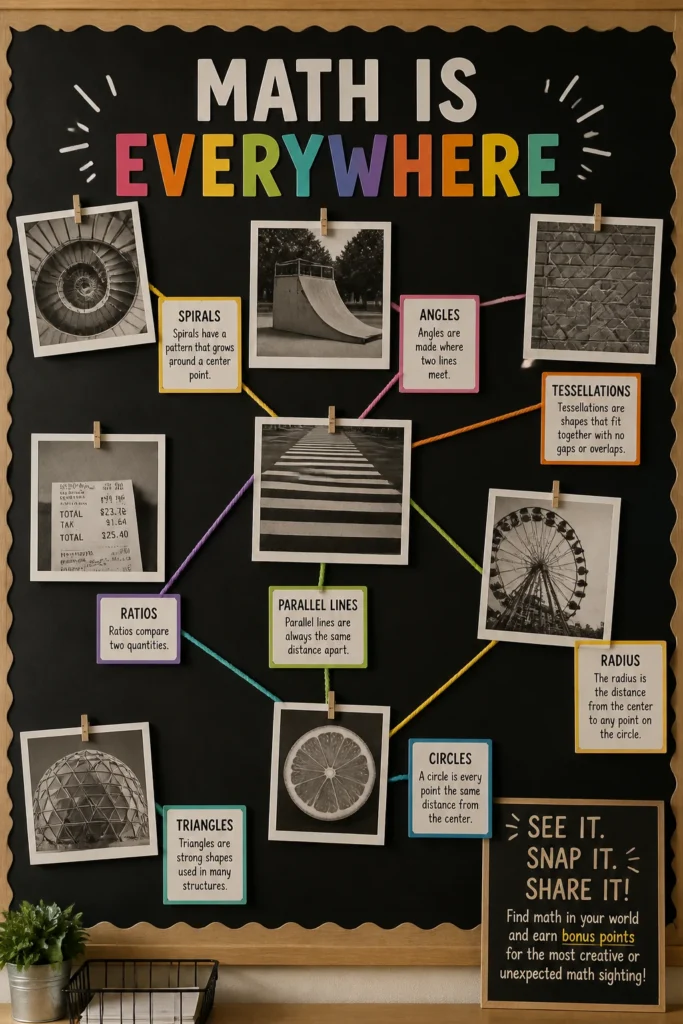
Pro Tip: Offer bonus points for the most creative or unexpected math sighting.
2. “Pi-rate Ship” Adventure
- Best For: March (Pi Day)
- Vibe: whimsical, educational
- Why it works: Makes learning about Pi fun and memorable.
Craft a large pirate ship out of brown butcher paper for the main display. Have students write out digits of Pi on “gold coins” or “treasure maps” and pin them around the ship. You can even add a cardboard “ocean” at the bottom with waves made from blue construction paper.
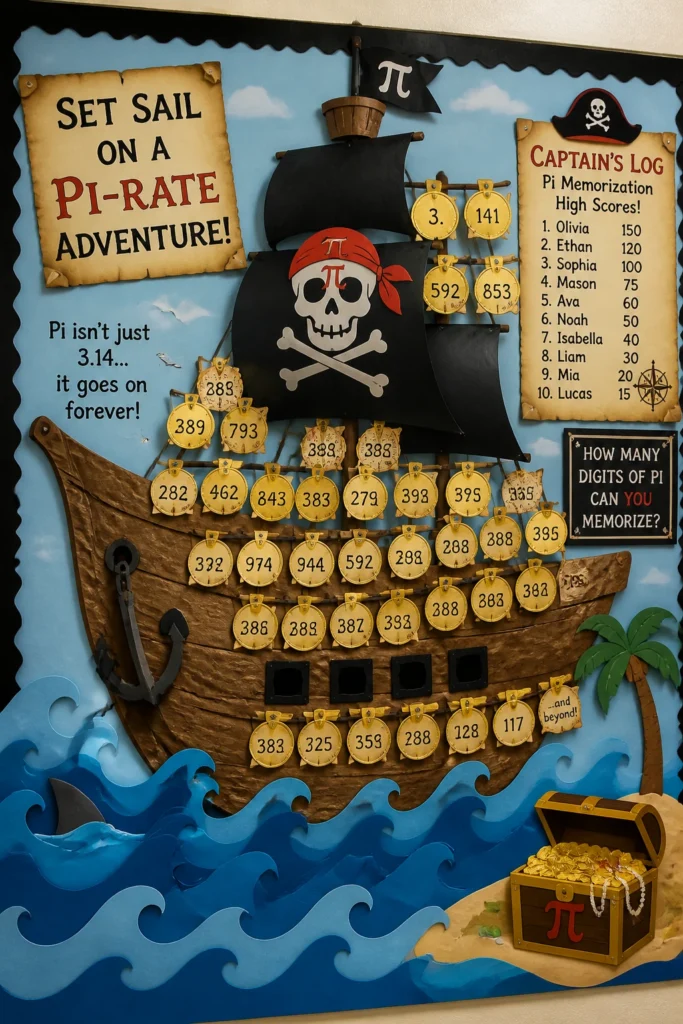
Pro Tip: Challenge students to memorize as many digits of Pi as possible and add their names to a “Captain’s Log” for their high scores.
3. “Graphing Your Future” Vision Board
- Best For: goal setting, career exploration
- Vibe: aspirational, personal
- Why it works: Connects math skills to future success and personal goals.
Create a giant coordinate plane as the background. Students can place images or words representing their future aspirations (dream job, college, hobbies) at specific “coordinates.” They then write a short blurb explaining how math will help them reach that point, perhaps using a line graph to show progress.
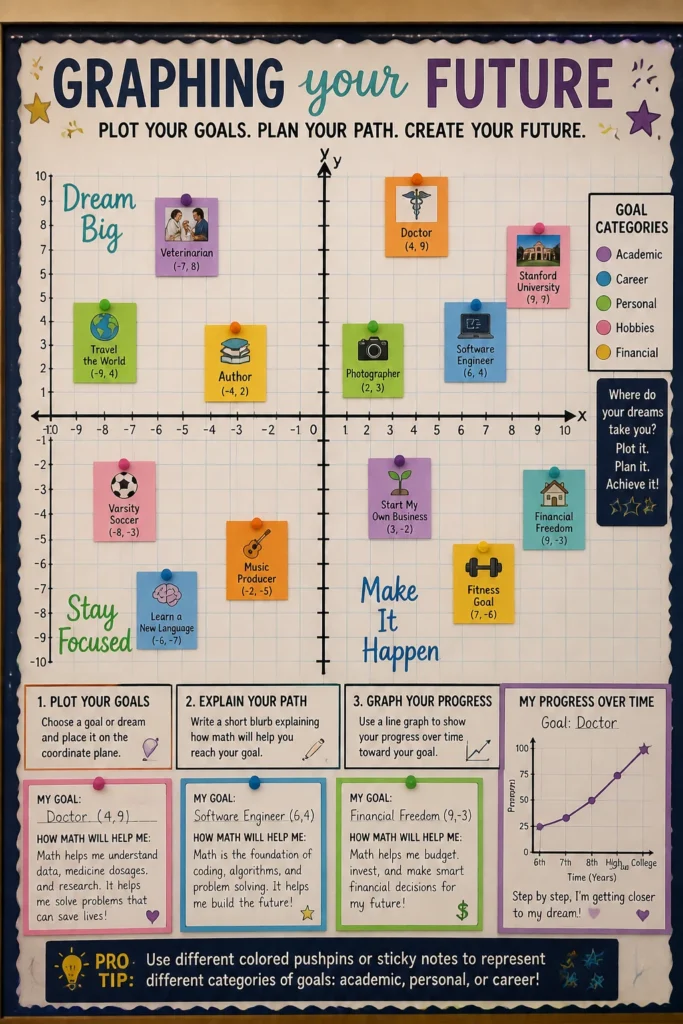
Pro Tip: Use different colored pushpins or sticky notes to represent different categories of goals, like academic, personal, or career.
4. “Order of Operations” Diner Menu
- Best For: PEMDAS review
- Vibe: retro, quirky
- Why it works: Transforms a complex rule into an easy-to-digest, fun visual.
Design a diner menu with “appetizers” (parentheses), “main courses” (multiplication/division), and “desserts” (addition/subtraction). Each section lists example problems. Use classic diner colors like red, white, and turquoise.
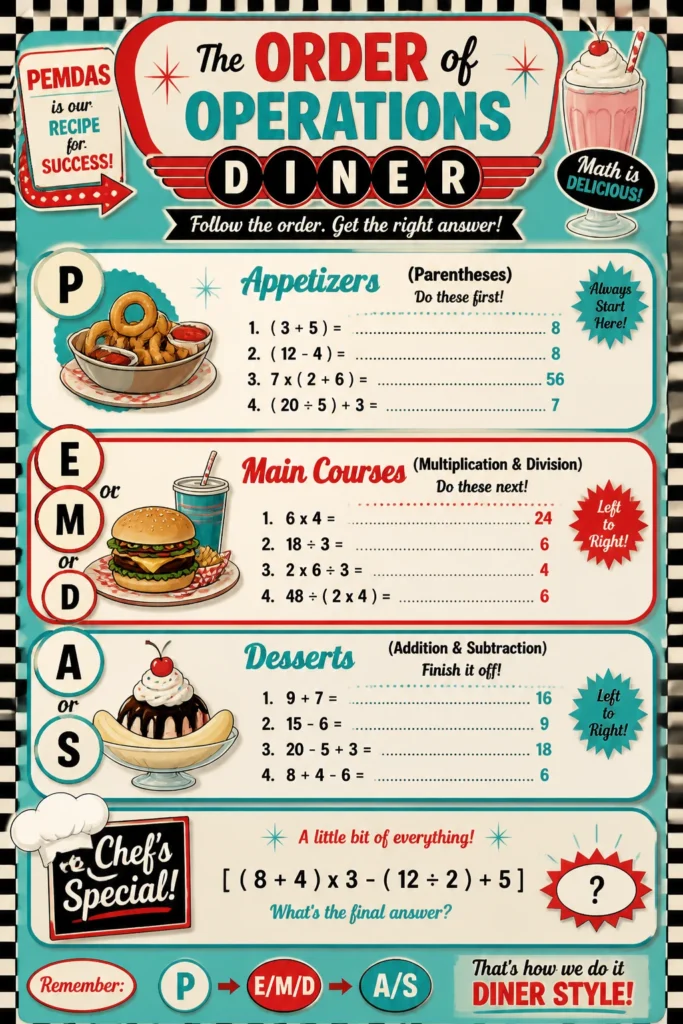
Pro Tip: Include a “Chef’s Special” problem that combines all operations for a real challenge.
5. “Angle Avengers” Superhero Display
- Best For: geometry unit
- Vibe: heroic, dynamic
- Why it works: Personifies angles, making them more engaging and easier to remember.
Create superhero characters for different types of angles: Captain Acute (small and mighty), Right-Angle Ranger (always standing tall), and Obtuse Overlord (big and broad). Give them capes and masks made from felt or construction paper. Show examples of each angle type they “protect.”
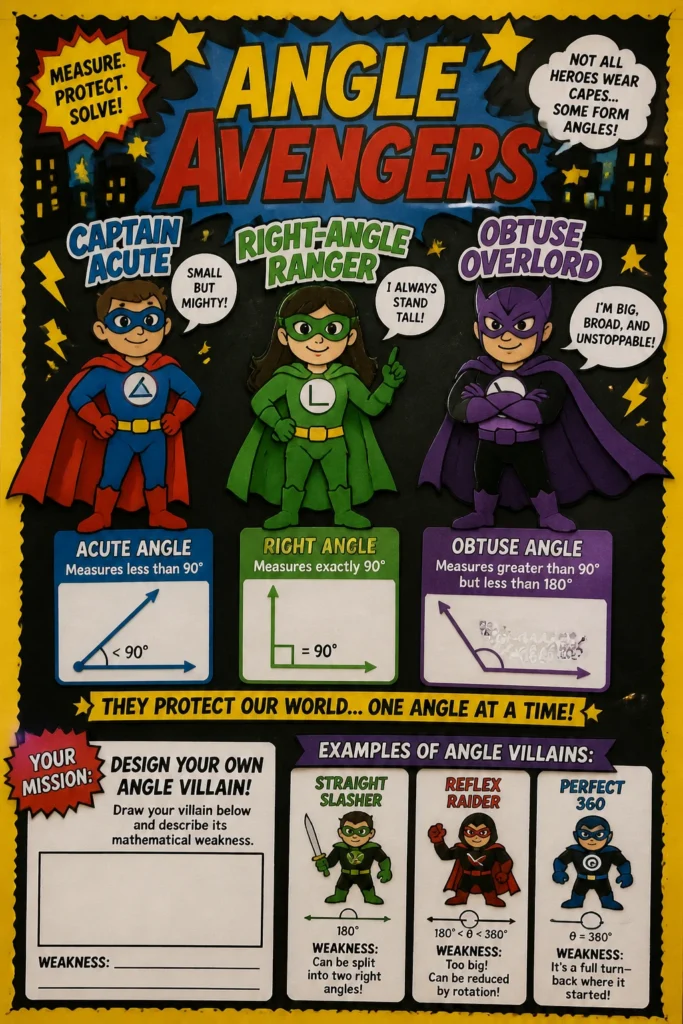
Pro Tip: Have students design their own “angle villain” and describe its mathematical weakness.
6. “Fraction Fall” Leaf Display
- Best For: autumn, fraction review
- Vibe: seasonal, cozy
- Why it works: Uses a natural theme to illustrate fraction concepts in a visually appealing way.
Cut out various leaf shapes from different colored construction paper – reds, oranges, yellows, browns. On each leaf, write a fraction. Group leaves by equivalent fractions or by operations (e.g., leaves that add up to one whole).
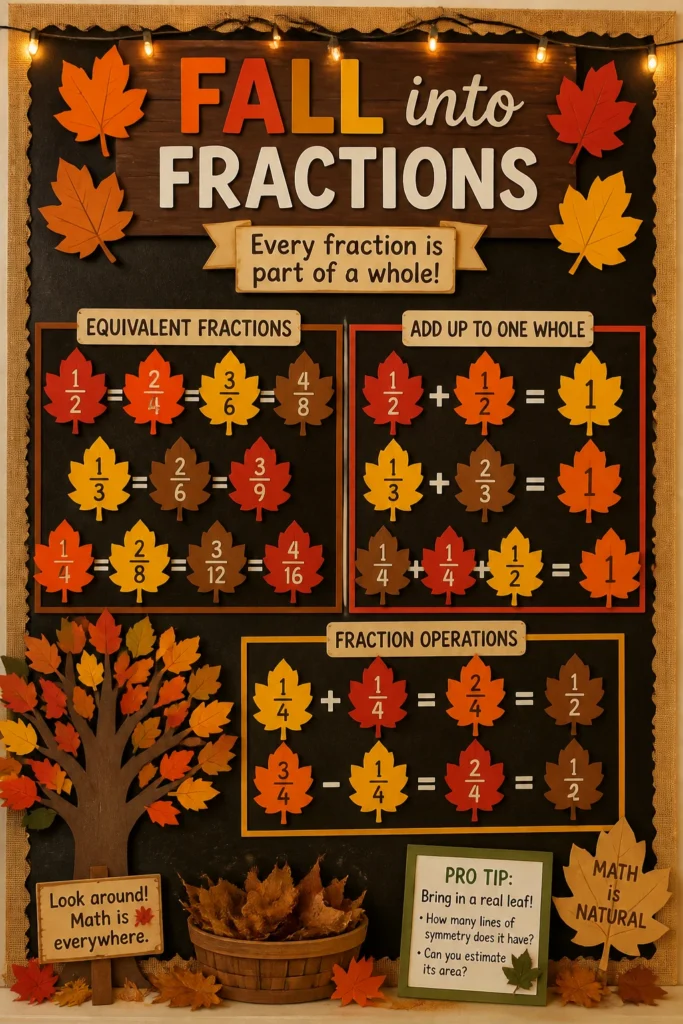
Pro Tip: Ask students to bring in real leaves and identify their symmetrical properties or estimate their area.
7. “The Great Math Debate” Pro/Con Board
- Best For: critical thinking, problem-solving
- Vibe: intellectual, thought-provoking
- Why it works: Encourages students to think deeply about math’s role and challenges.
Divide the board into two sections: “Pros of Math” and “Cons of Math (or challenges).” Students can write their thoughts on sticky notes and place them in the appropriate section. This sparks conversation and shows diverse perspectives.
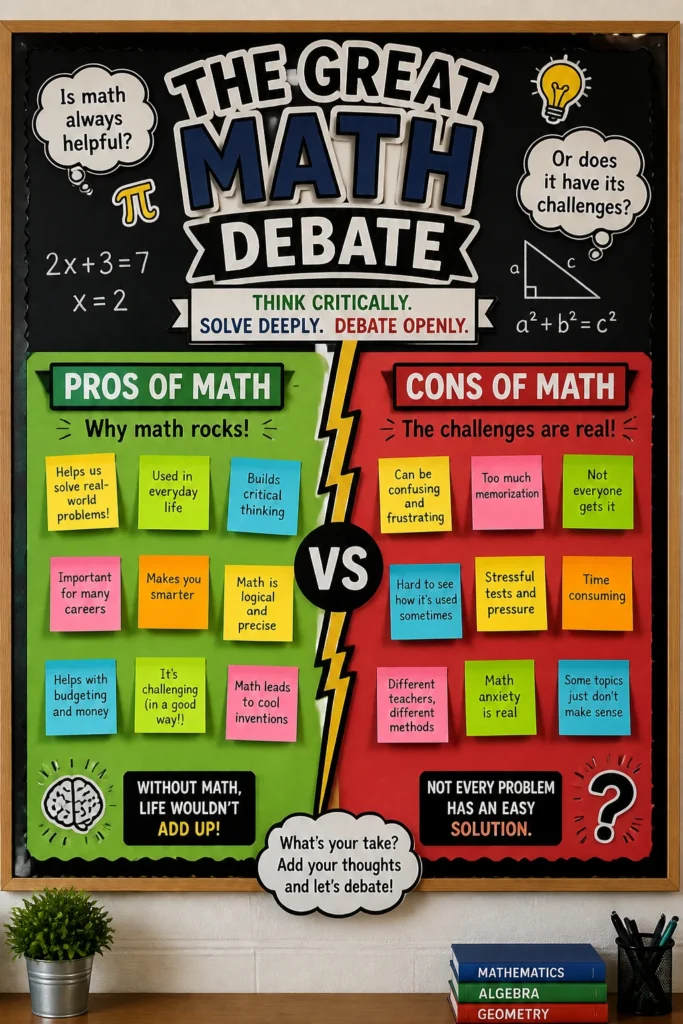
Pro Tip: Introduce a specific math problem or concept and have students debate its usefulness or difficulty.
8. “Math History Timeline” Scrolls
- Best For: historical context, enrichment
- Vibe: scholarly, ancient
- Why it works: Shows the evolution of mathematical thought and famous contributors.
Create a long timeline across the board, perhaps with a parchment-paper look. Students research famous mathematicians or key mathematical discoveries (e.g., Pythagoras, invention of zero). They write brief summaries on “scrolls” made from rolled-up brown paper and pin them to the timeline.
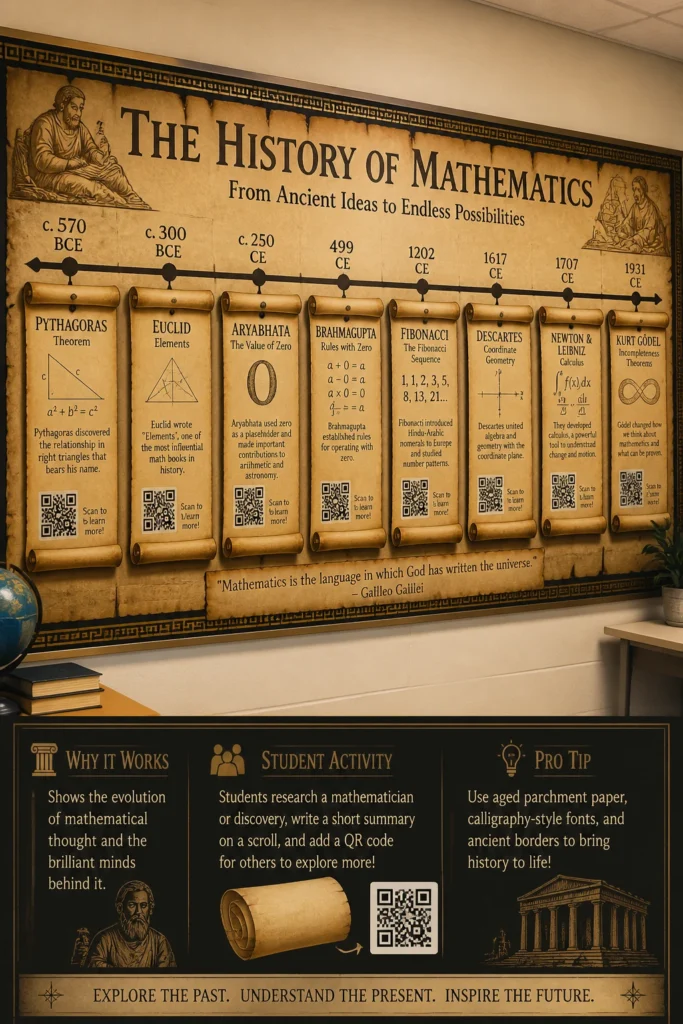
Pro Tip: Include a QR code next to each scroll linking to a short video or article for more in-depth learning.
9. “Data Donut Shop” Bar Graphs
- Best For: statistics, data representation
- Vibe: sweet, interactive
- Why it works: Makes graphing data delicious and visually appealing.
Draw various donut shapes on colorful paper. Each donut represents a category (e.g., “favorite topping,” “number of siblings,” “hours spent gaming”). Students color in sections of the donut to represent their data, creating a class-wide bar graph or pie chart.
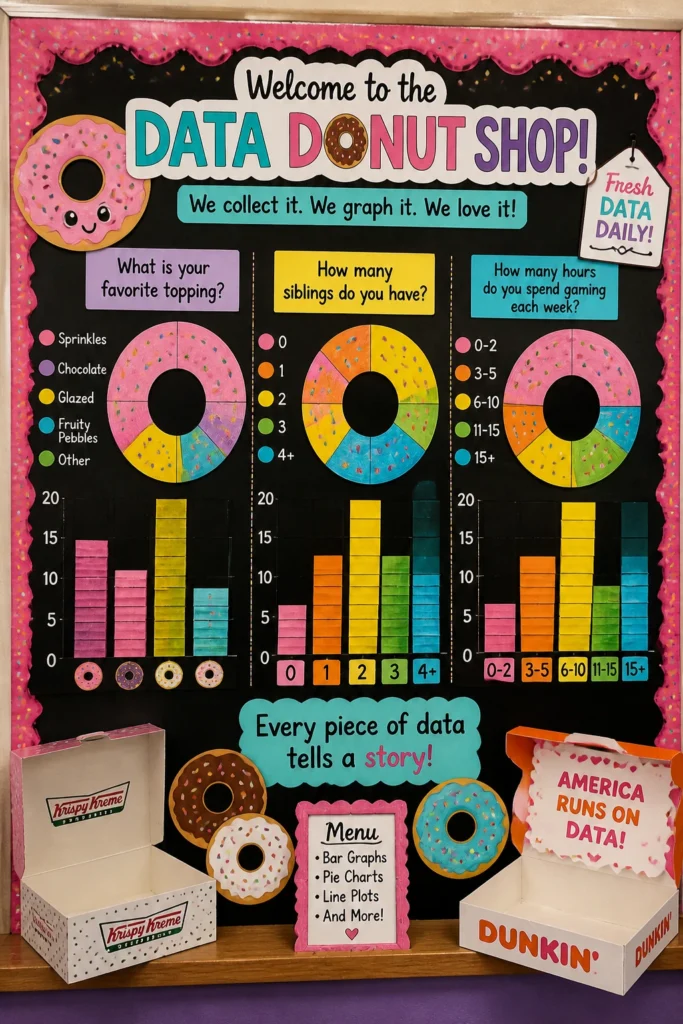
Pro Tip: Use actual donut boxes or wrappers as decorative elements around the board. Just make sure they’re empty, unless you’re feeling extra generous.
10. “Guess the Equation” Mystery Board
- Best For: problem-solving, review
- Vibe: puzzling, interactive
- Why it works: Engages students with a continuous challenge that encourages mathematical thinking.
Post a series of visual clues or riddles that, when solved, lead to a specific mathematical equation or concept. Students write their guesses on slips of paper and drop them into a decorated box. Change the mystery weekly.
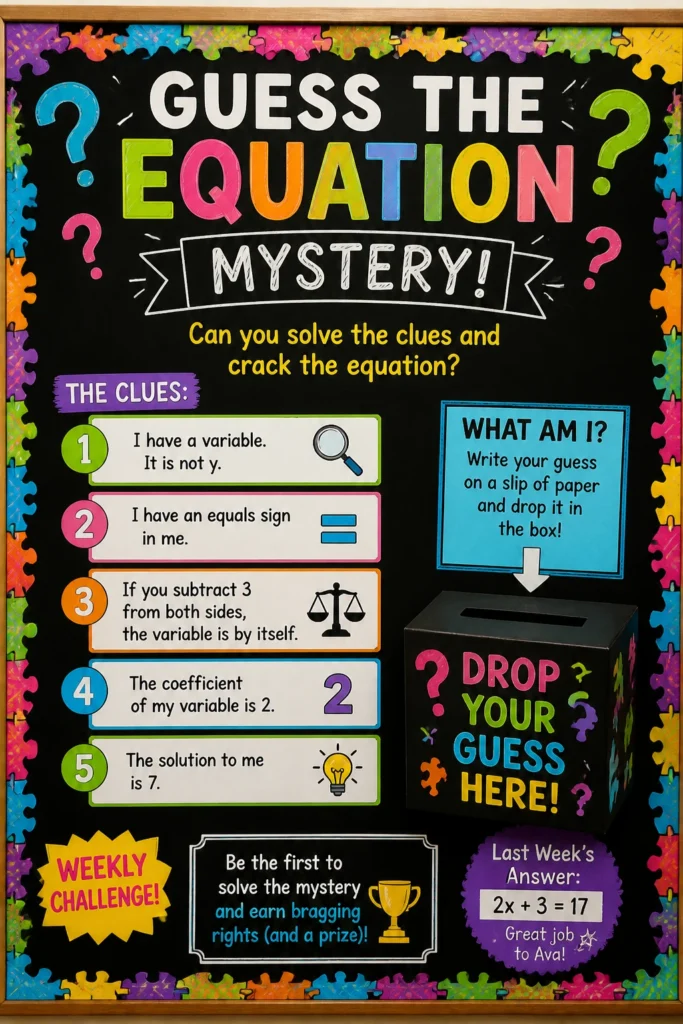
Pro Tip: Offer a small prize or bragging rights to the first student who correctly solves the mystery each week.
Our Top Recommended Finds
- Colorful Cardstock Assortment: You’ll need a rainbow of paper to make those bulletin boards pop and differentiate ideas.
- Heavy-Duty Staple Gun: Because flimsy thumbtacks are a rookie move, and you want those masterpieces to stay put all year.
- Laminating Machine (personal size): Protect your hard work from enthusiastic middle schoolers and ensure your creations last for seasons.
Which of these will you try first?
So, there you have it, fellow math whisperers! Ten ways to turn that bland board into a beacon of numerical brilliance.
You’re basically a design guru now, just with more theorems and less avocado toast.
Which one are you tacking up first? Let us know your faves in the comments!