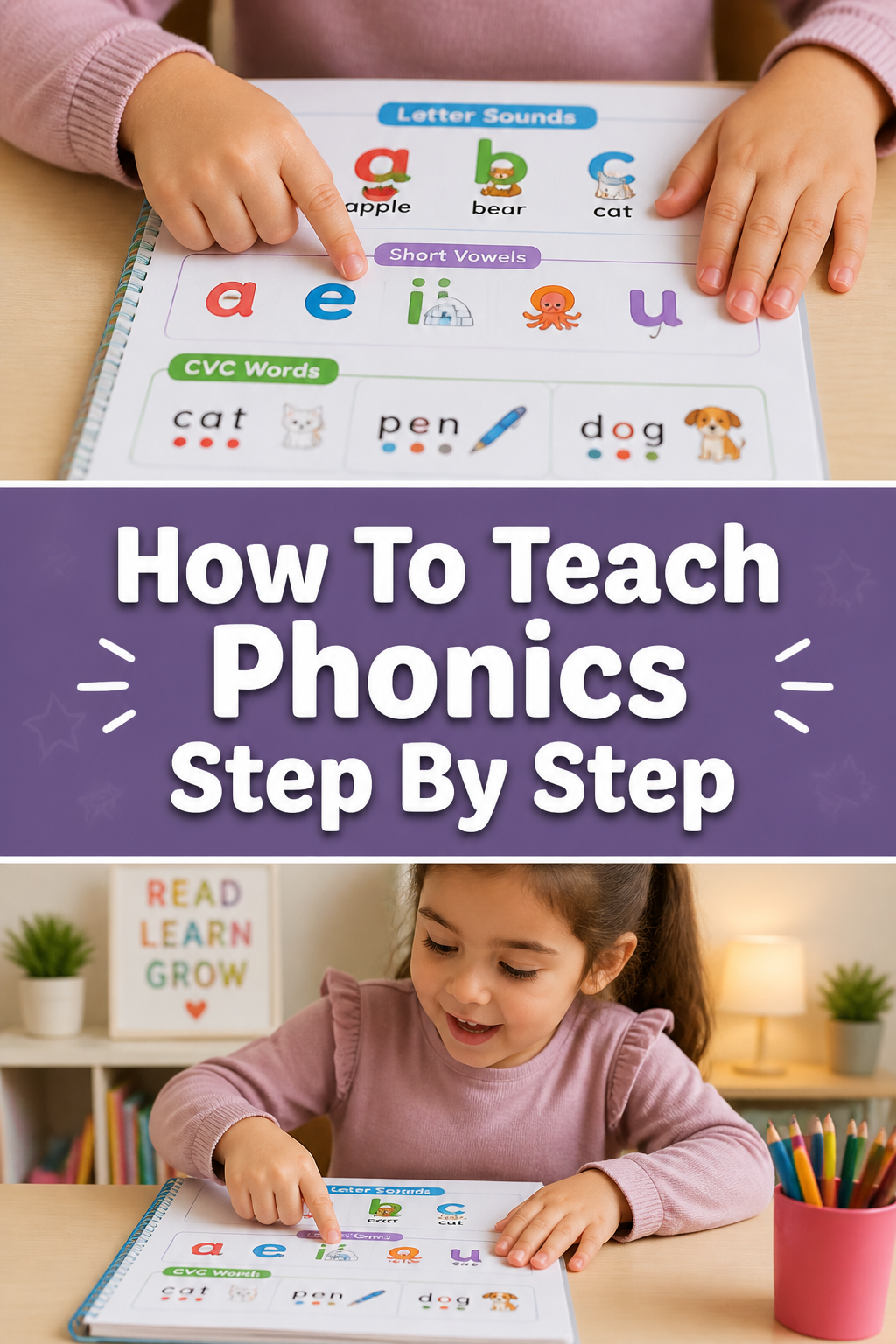
📚 How To Teach Phonics Step By Step
Learning to read is a monumental journey for any child.
As an educator and parent, I’ve seen firsthand the transformative power of effective phonics instruction.
This guide shares practical methods I’ve refined over years, empowering you to confidently teach phonics to your learner.

Quick Overview
By following these steps, you’ll gain the confidence and strategies to systematically teach phonics, building a strong foundation for reading and spelling in your child or student.
- Time needed: Ongoing commitment, with initial preparation 1-2 hours
- Difficulty: Beginner
- What you’ll need: Alphabet letters (physical or digital), simple books, a whiteboard or paper, and consistent enthusiasm
Step-by-Step Instructions
Step 1: Understand Phonics Basics
Before you begin teaching, grasp the core principles of phonics. Phonics connects sounds (phonemes) to letters (graphemes).
It helps children decode words by sounding them out and encode words by spelling them.
- Familiarize yourself with the 44 phonemes of the English language. You don’t need to memorize them all at once, but know that sounds are the building blocks.
- Learn the difference between letter names and letter sounds. Children learn to read using sounds, not names, initially.
- Recognize that phonics is systematic. It follows a logical progression, starting with simple sounds and building complexity.
Pro Tip: There are many online resources and apps that demonstrate the 44 phonemes. Listening to them will help you pronounce them correctly for your learner.
Step 2: Start with Letter Sounds (Phonemes)
Begin by teaching the most common sound for each letter of the alphabet. Focus on short vowel sounds and continuous consonant sounds first.
Avoid teaching letter names at this stage, as it can cause confusion.
- Introduce one sound at a time. For example, start with ‘m’, ‘s’, ‘a’, ‘t’, ‘p’, ‘i’, ‘n’. These letters allow for early word blending.
- Use a clear, crisp pronunciation for each sound. Try to isolate the sound without adding an “uh” at the end (e.g., “m” not “muh”).
- Connect the sound to a visual. Show the letter ‘m’ and say /m/. Have the child repeat the sound.
- Practice identifying the sound in words. Say “apple” and ask, “What sound do you hear at the beginning of apple?”
Step 3: Blend Sounds to Read Words
Once your learner knows a few letter sounds, introduce blending. Blending is the process of putting individual sounds together to form a word.
This is where the magic of reading truly begins.
- Start with CVC (consonant-vowel-consonant) words using the sounds they know. For example, ‘cat’, ‘mat’, ‘sit’, ‘pin’.
- Model the blending process. Point to each letter, make its sound, and then smoothly combine them: “/c/ /a/ /t/ – cat.”
- Use physical letter tiles or magnetic letters to help. Arrange ‘c-a-t’, then slide your finger under them as you blend.
- Encourage the child to try blending on their own. Provide gentle correction and plenty of praise.
Pro Tip: Keep blending sessions short and focused. Celebrate every successful blend, no matter how small. Repetition is key here.
Step 4: Introduce Digraphs and Trigraphs
After mastering basic CVC blending, introduce digraphs and trigraphs. These are groups of two or three letters that make one sound.
Common digraphs include ‘sh’, ‘ch’, ‘th’, ‘wh’, ‘ck’, ‘ai’, ‘ee’, ‘oa’, ‘oo’. Trigraphs include ‘igh’, ‘dge’, ‘tch’.
- Explain that these letter combinations act as a single sound unit. For example, ‘sh’ makes the /sh/ sound, not /s/ /h/.
- Teach one digraph or trigraph at a time. Show the letters together and say the sound.
- Practice blending words that contain these new units. For ‘sh’, blend words like ‘ship’, ‘shop’, ‘fish’.
- Use visual aids that group the letters together, perhaps drawing an arc under them to signify they’re one sound.
Step 5: Practice Decoding and Encoding
Phonics isn’t just about reading (decoding); it’s also about spelling (encoding). These skills reinforce each other.
When a child can sound out a word to read it, they can also break it down into sounds to spell it.
- Decoding practice: Provide decodable books or word lists that only contain sounds and patterns the child has learned.
- Encoding practice: Dictate simple words for the child to write. Say “cat” and ask them to write the letters for each sound they hear.
- Segment words into sounds for spelling. Say “fish” and ask, “What sounds do you hear in fish? /f/ /i/ /sh/.”
- Use whiteboards or sand trays for a multi-sensory approach to writing the sounds.
Step 6: Incorporate Sight Words Strategically
Not all words are perfectly decodable using phonics rules. Some words, often called “sight words” or “high-frequency words,” have irregular spellings or appear so frequently they need to be recognized instantly.
Introduce these alongside your phonics instruction.
- Identify a small set of high-frequency words that are not easily decodable (e.g., ‘the’, ‘said’, ‘was’).
- Teach these words by rote memorization or by pointing out the decodable parts and the “tricky” parts. For ‘said’, point out ‘s’ and ‘d’ are regular, but ‘ai’ is tricky.
- Practice these words frequently through flashcards, games, and finding them in books.
- Balance sight word instruction with phonics. Phonics should always be the primary teaching method.
Step 7: Make it Fun and Engaging
Learning should be an enjoyable experience. Incorporate games, movement, and creativity to keep your learner motivated and eager to participate.
A playful approach makes lessons more memorable.
- Play ‘I Spy’ with sounds: “I spy something that starts with /m/.”
- Use phonics-based apps and online games that reinforce learned sounds and blending.
- Sing alphabet sound songs or create your own jingles for tricky sounds.
- Incorporate movement. Have the child jump for each sound in a word or clap syllables.
Pro Tip: Keep sessions short, especially for younger learners (10-15 minutes). Little and often is far more effective than long, infrequent lessons.
Step 8: Assess and Adapt
Regularly check your learner’s understanding and adjust your teaching as needed. Every child progresses at their own pace.
Be patient and responsive to their individual needs.
- Observe their blending and segmenting skills during practice.
- Review previously taught sounds and words to ensure mastery before moving on.
- Identify any specific sounds or blending patterns they struggle with and dedicate extra practice to those areas.
- Celebrate progress and effort, reinforcing a positive attitude towards learning.
Common Mistakes to Avoid
Rushing the Process
One of the biggest pitfalls is moving too quickly through the phonics stages. Children need ample time to master each sound and blending skill before new ones are introduced. Rushing can lead to gaps in understanding and frustration.
Instead, prioritize mastery over speed. Go back and review concepts if a child is struggling, ensuring a solid foundation before advancing.
Overlooking Phonemic Awareness
Phonemic awareness is the ability to hear, identify, and manipulate individual sounds (phonemes) in spoken words. It’s a precursor to phonics. Skipping this crucial pre-reading skill can make phonics much harder.
Dedicate time to activities like rhyming, identifying initial/final sounds, segmenting words into sounds orally, and blending sounds orally, even before introducing letters.
Relying Solely on Worksheets
While worksheets can have a place, making them the sole or primary method of phonics instruction can be boring and ineffective. Phonics is an active, auditory skill.
Integrate a variety of multi-sensory activities: using magnetic letters, building words with blocks, writing in sand, playing sound games, and reading decodable books.
Neglecting Review
It’s easy to teach a new sound and then move on, assuming it’s learned. However, consistent review is vital for retention. Without it, previously learned sounds and patterns can be forgotten.
Incorporate quick reviews of old sounds and words at the start of each session. Use games or flashcards for rapid recall, ensuring that knowledge is consolidated over time.
Troubleshooting
Child is Struggling to Blend
If your child finds it hard to smoothly combine sounds, they might be saying each sound in isolation rather than flowing them together. This is a common hurdle.
Try using a “stretchy snake” voice, elongating continuous sounds like /m/, /s/, /f/ and then blending them into the next sound. Use physical cues like sliding your finger under the letters as you blend, emphasizing the smooth transition.
Child Lacks Motivation
Boredom or frustration can quickly dampen a child’s enthusiasm for phonics. If they seem disengaged, the activities might be too hard, too long, or not engaging enough.
Shorten sessions, introduce more games, or let the child choose an activity. Incorporate their interests. If they love dinosaurs, find words related to dinosaurs. Keep it light, positive, and full of praise for effort, not just perfection.
Confusion with Similar Sounds
Some sounds, like /b/ and /d/, or short /e/ and short /i/, can be tricky for children to differentiate. This often happens because their mouth positions are similar.
Focus on one tricky sound at a time, providing clear pronunciation and visual cues (e.g., show how your mouth looks for /b/ vs. /d/). Use minimal pair words (e.g., ‘bat’ vs. ‘dat’) for focused practice, and tactile methods like tracing the letter shape while saying the sound.
Key Takeaways
- Phonics teaches the link between sounds and letters for reading and spelling.
- Start by mastering individual letter sounds before moving to blending.
- Systematic progression, from CVC words to digraphs, is crucial.
- Combine decoding (reading) and encoding (spelling) for robust learning.
- Integrate high-frequency sight words thoughtfully, but prioritize phonics.
- Keep learning fun, engaging, and multi-sensory to maintain motivation.
- Regularly assess progress and adapt your approach to suit the learner.
Frequently Asked Questions
When should I start teaching phonics?
Most children are ready for formal phonics instruction around ages 4-5, typically in preschool or kindergarten. However, foundational phonemic awareness activities can begin even earlier, around age 3, by playing with sounds and rhymes.
How long should a phonics session be?
For young learners, short, frequent sessions are most effective. Aim for 10-15 minutes, two to three times a day, rather than one long session. For older children or those with more developed attention spans, sessions might extend to 20-30 minutes.
What’s the difference between phonics and phonemic awareness?
Phonemic awareness is the ability to hear and manipulate individual sounds in spoken words without seeing the letters. Phonics connects these sounds to their written letter symbols. Phonemic awareness is an auditory skill, while phonics involves both auditory and visual elements.
Can I teach phonics if I’m not a teacher?
Absolutely! Many parents successfully teach phonics at home. With a clear, systematic approach and consistent practice, you can effectively guide your child. This guide provides the framework and confidence you need to start.
Our Top Recommended Finds
- Magnetic Letters: These are fantastic for hands-on word building and blending practice on a fridge or magnetic board.
- Phonics Flashcards: A good set of flashcards for individual letter sounds, digraphs, and sight words can be invaluable for quick review.
- Decodable Readers: Books specifically designed with controlled vocabulary that only uses sounds and patterns the child has learned. These build confidence and apply phonics skills directly.
Empowering Your Reader’s Journey
Teaching phonics is one of the most rewarding educational endeavors you can undertake. You are not just teaching a skill; you are opening up the world of books and knowledge.
Embrace patience, celebrate every small victory, and remember that consistency is your most powerful tool.
Start today, and watch your learner’s confidence and abilities blossom with each sound they master and every word they read.