📝 How To Use Sticky Notes To Study
I remember staring at a 500-page biology textbook feeling completely paralyzed by the sheer volume of facts.
Everything changed when I bought a $2 pack of neon sticky notes and started treating my wall like a living brain map.
This guide comes from years of trial and error in university libraries where I perfected the art of visual learning through simple paper squares.

Quick Overview
This guide will show you how to transform a messy pile of information into a structured, visual study system.
- Time needed: 30–60 minutes per study session
- Difficulty: Beginner
- What you’ll need: Multi-colored sticky notes, fine-tip markers, a flat surface (wall or desk), and your textbook or notes.
Step-by-Step Instructions
Step 1: Establish a Color-Coding Legend
Before you write a single word, you need to assign meanings to your colors. Choose specific colors for different types of information to help your brain categorize data instantly.
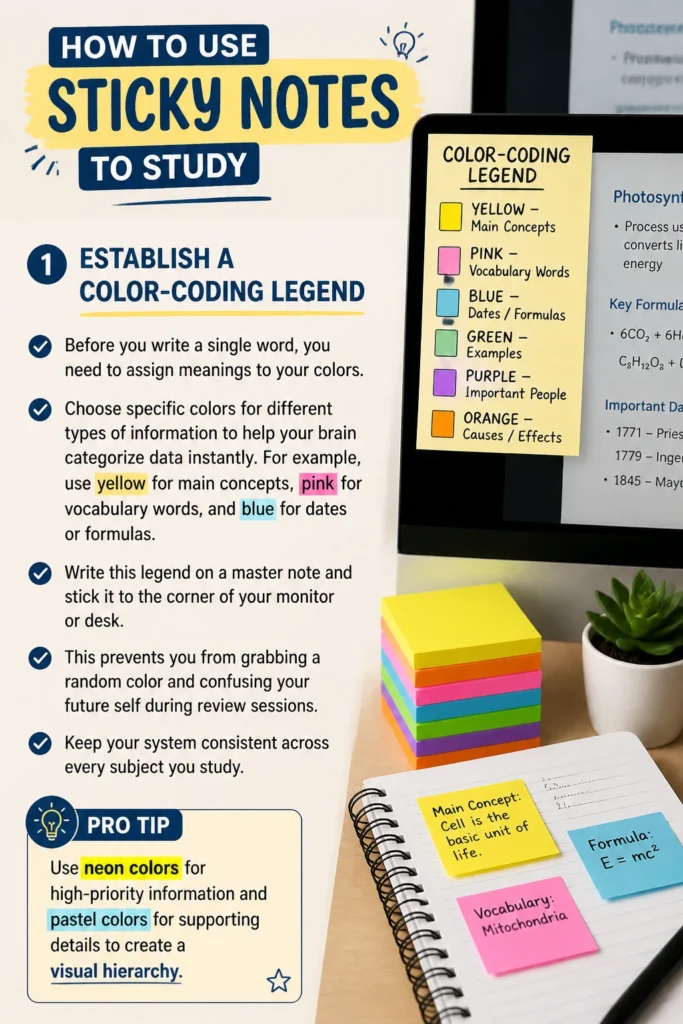
For example, use yellow for main concepts, pink for vocabulary words, and blue for dates or formulas. Write this legend on a master note and stick it to the corner of your monitor or desk.
This prevents you from grabbing a random color and confusing your future self during review sessions. Keep your system consistent across every subject you study.
Pro Tip: Use neon colors for high-priority information and pastel colors for supporting details to create a visual hierarchy.
Step 2: Master the Proper Peeling Technique
Most students peel sticky notes from the bottom upward, which causes the paper to curl and fall off the wall. Peel your notes from the side to ensure they lay flat against any surface.
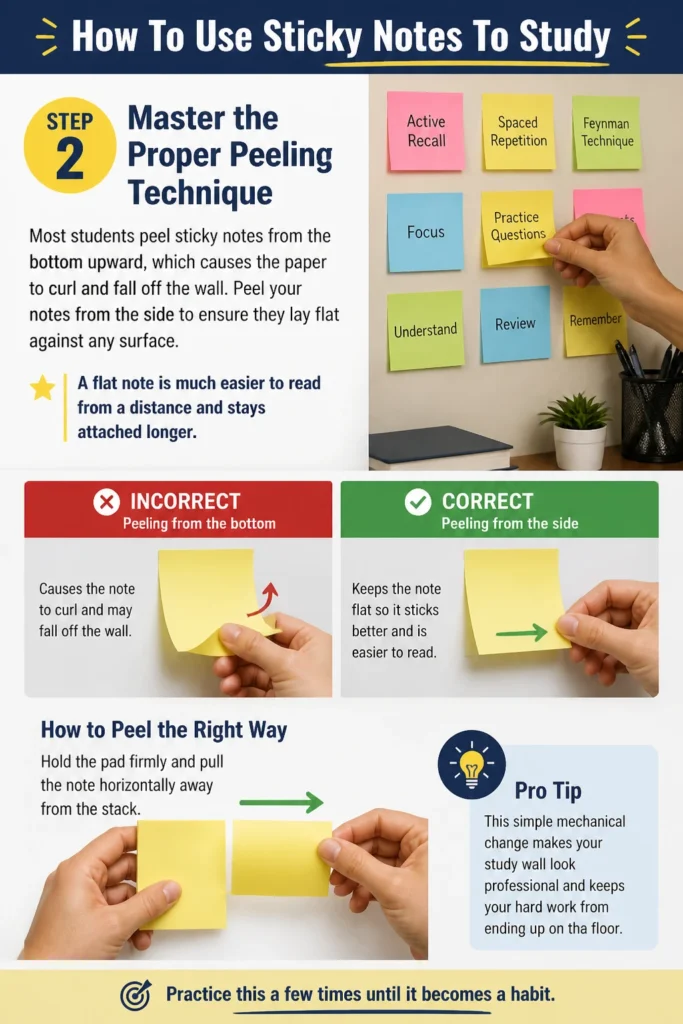
A flat note is much easier to read from a distance and stays attached longer. Hold the pad firmly and pull the note horizontally away from the stack.
This simple mechanical change makes your study wall look professional and keeps your hard work from ending up on the floor. Practice this a few times until it becomes a habit.
Step 3: Implement the One-Concept Rule
The biggest mistake is trying to fit an entire paragraph onto one small square. Limit each sticky note to a single idea, formula, or fact.
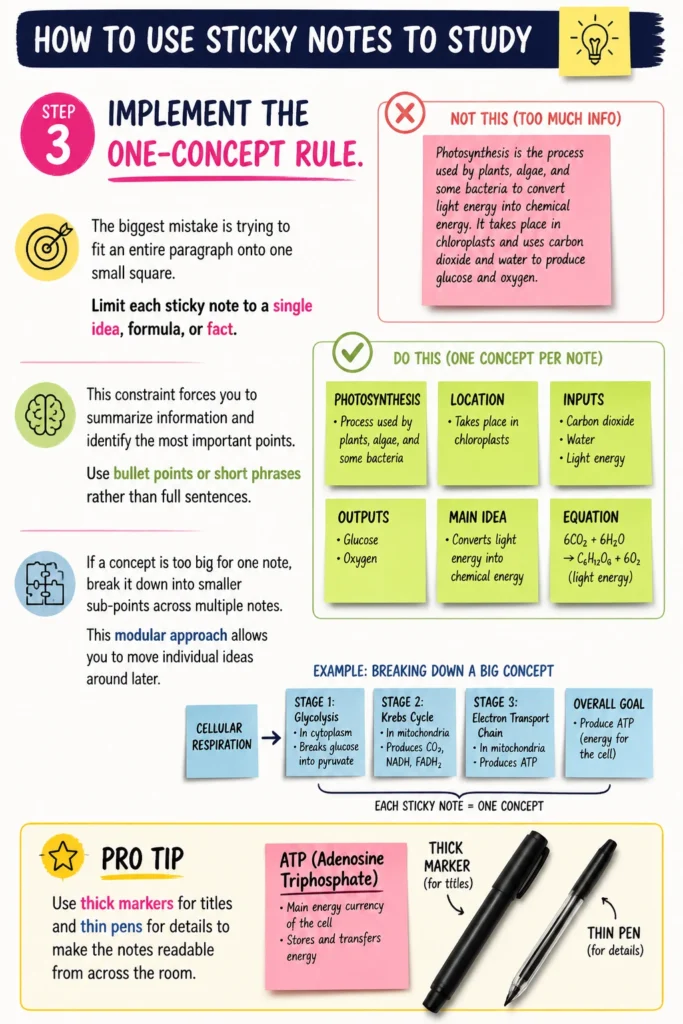
This constraint forces you to summarize information and identify the most important points. Use bullet points or short phrases rather than full sentences.
If a concept is too big for one note, break it down into smaller sub-points across multiple notes. This modular approach allows you to move individual ideas around later.
Pro Tip: Use thick markers for titles and thin pens for details to make the notes readable from across the room.
Step 4: Create a Moveable Mind Map
Traditional mind maps on paper are permanent and hard to change. Arrange your sticky notes on a large wall or window to create a flexible map of your subject.
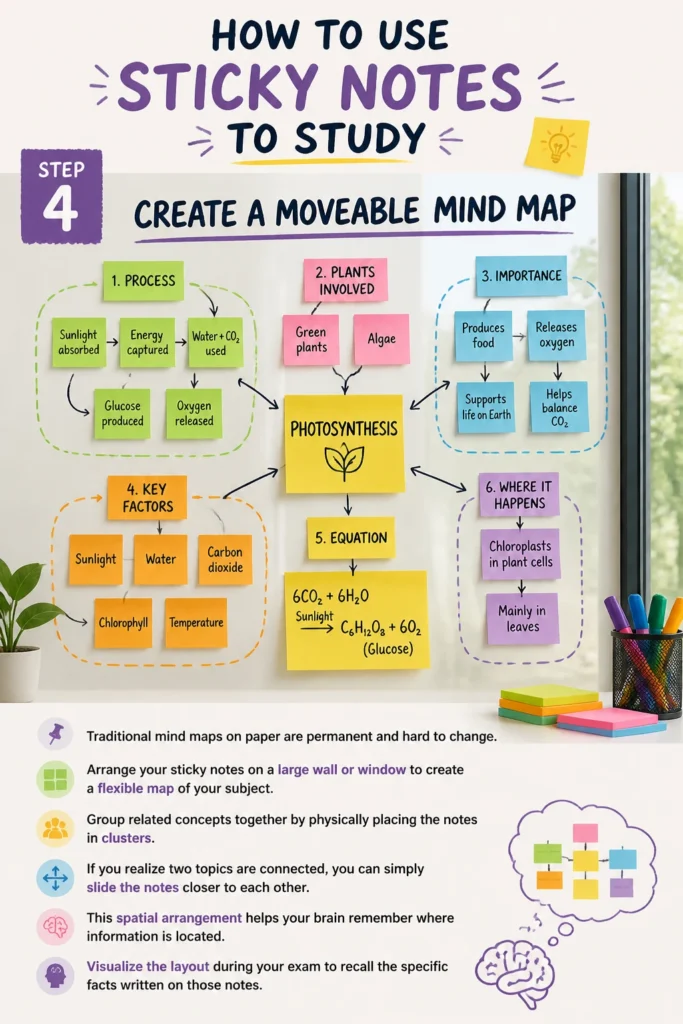
Group related concepts together by physically placing the notes in clusters. If you realize two topics are connected, you can simply slide the notes closer to each other.
This spatial arrangement helps your brain remember where information is located. Visualize the layout during your exam to recall the specific facts written on those notes.
Step 5: Use Hidden Answer Flashcards
You can turn your textbook into an interactive quiz tool without marking the pages. Write a question on a sticky note and place it directly over the answer in your book.
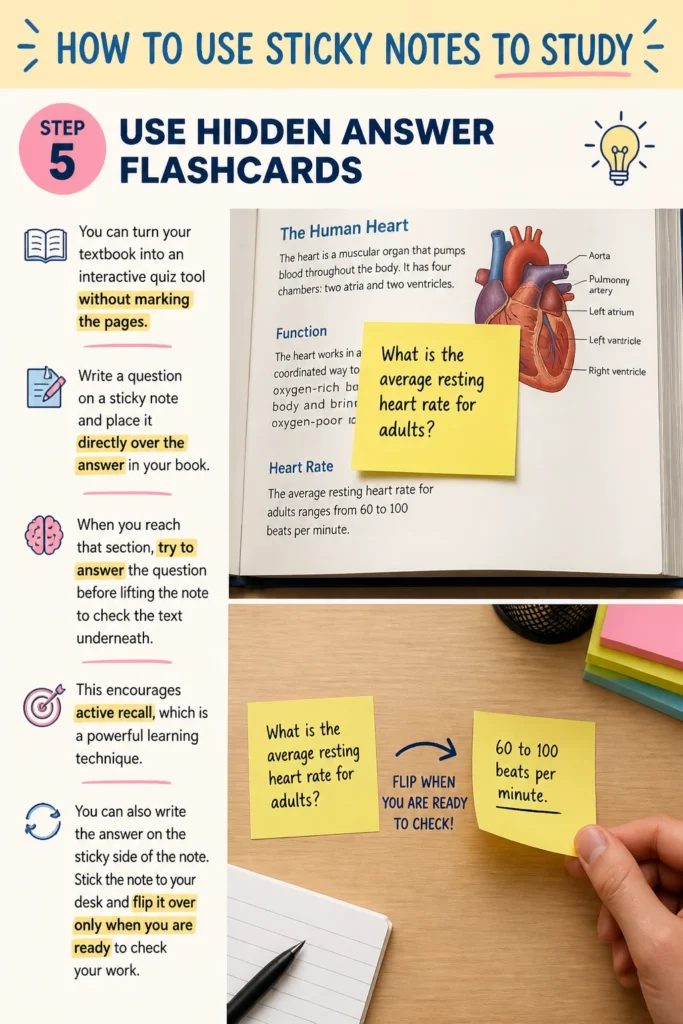
When you reach that section, try to answer the question before lifting the note to check the text underneath. This encourages active recall, which is a powerful learning technique.
You can also write the answer on the sticky side of the note. Stick the note to your desk and flip it over only when you are ready to check your work.
Step 6: Build a Progress Kanban Board
Visualizing your progress reduces anxiety and keeps you motivated. Divide your workspace into three sections: “To Learn,” “Learning,” and “Mastered.”
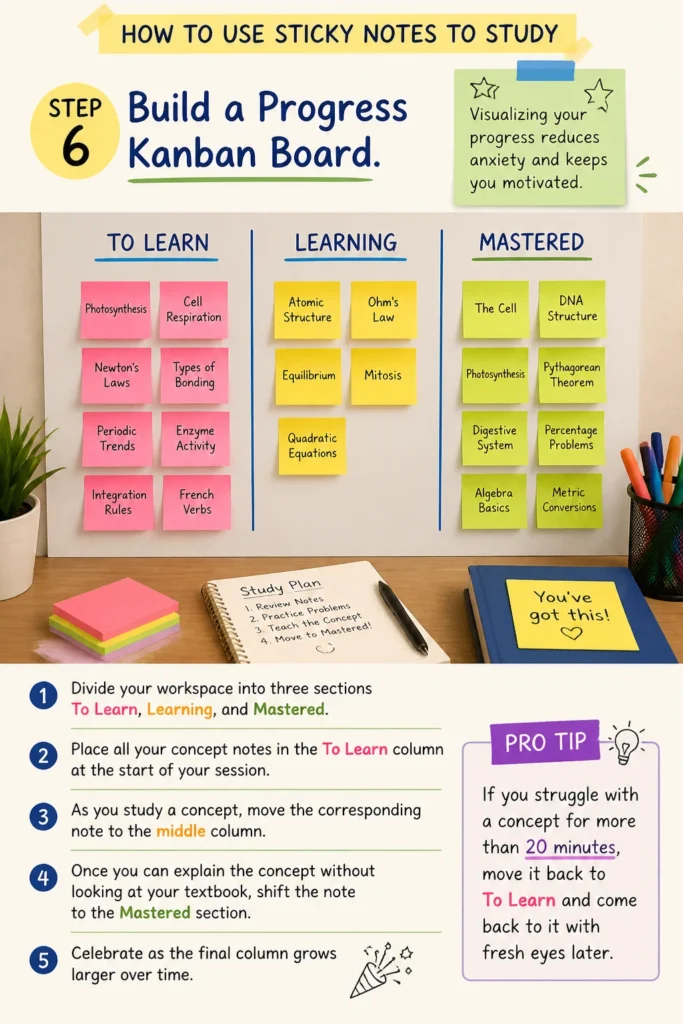
Place all your concept notes in the “To Learn” column at the start of your session. As you study a concept, move the corresponding note to the middle column.
Once you can explain the concept without looking at your textbook, shift the note to the “Mastered” section. Celebrate as the final column grows larger over time.
Pro Tip: If you struggle with a concept for more than 20 minutes, move it back to “To Learn” and come back to it with fresh eyes later.
Step 7: Annotate Without Damaging Books
Rented textbooks or library books shouldn’t be highlighted or written in. Place transparent or standard sticky notes over the margins to record your thoughts.

Draw arrows from your notes to specific lines of text to clarify complex passages. Summarize each page on a single note and stick it to the top corner for quick review.
When the semester ends, you can remove all your notes and leave the book in perfect condition. Transfer these notes to a notebook if you want to keep your summaries permanently.
Step 8: Practice Spaced Repetition
Sticky notes are perfect for reminders in high-traffic areas of your home. Stick difficult formulas or vocabulary words on your bathroom mirror or the back of your front door.
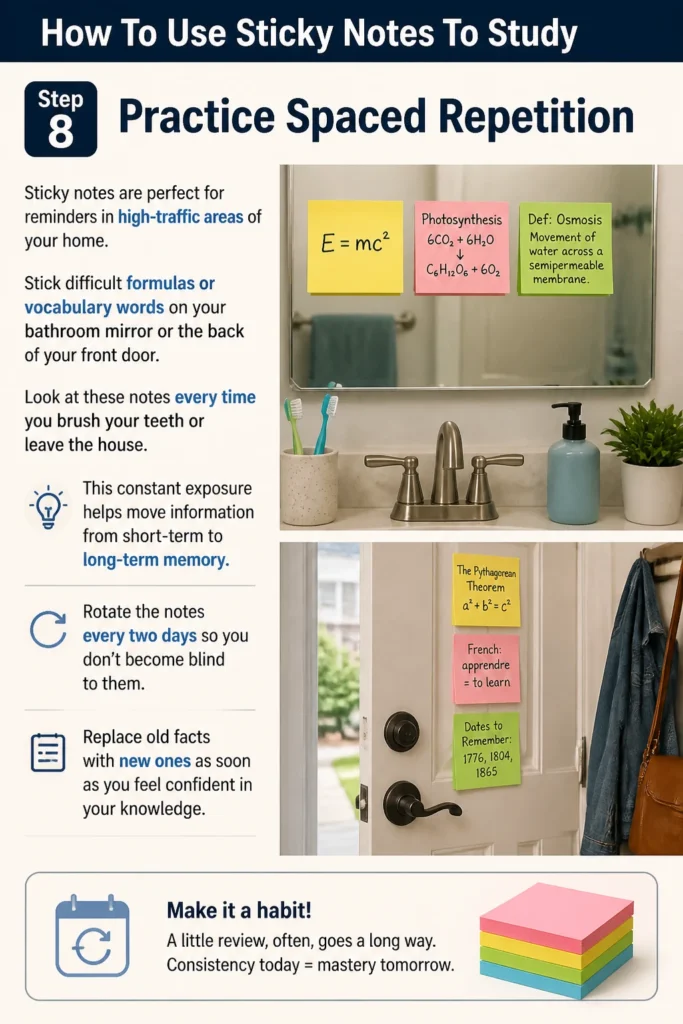
Look at these notes every time you brush your teeth or leave the house. This constant exposure helps move information from short-term to long-term memory.
Rotate the notes every two days so you don’t become “blind” to them. Replace old facts with new ones as soon as you feel confident in your knowledge.
Common Mistakes to Avoid
Overcrowding Your Workspace
Covering every inch of your wall in neon squares creates visual noise that distracts the brain. If you have too many notes, your eyes won’t know where to focus first. Keep your active study area limited to the current chapter or topic you are working on. Move older notes to a secondary location or store them in a dedicated notebook once you have learned them.
Writing Too Small
If you have to stand three inches away from the wall to read your notes, the visual benefit is lost. Use large, clear lettering that is legible from your chair. Small handwriting often indicates that you are trying to cram too much information onto a single note. If you can’t fit the idea in large letters, you need to simplify the concept further.
Ignoring the “Stick” Quality
Buying the cheapest off-brand notes often leads to frustration when they fall off overnight. There is nothing more discouraging than waking up to a floor covered in random facts you spent hours organizing. Invest in high-quality adhesive notes, especially if you plan to stick them on textured walls. Test a single note on your chosen surface for an hour before committing to a full wall display.
Troubleshooting
The Notes Keep Falling Off the Wall
This usually happens because of dust on the surface or the peeling technique mentioned earlier. Wipe the wall with a dry cloth before applying your notes to remove any invisible debris. If the surface is too textured, try sticking the notes to a large poster board or a glass window instead. You can also use a small piece of painter’s tape on the top of stubborn notes for extra security.
Feeling Overwhelmed by the Colors
If your color-coding system feels like a chore, simplify it immediately. You don’t need seven different colors to be effective. Try using just two: one for things you know and one for things you don’t. You can always add more complexity later once you are comfortable with the basic habit of using the notes.
Running Out of Space
When your wall is full, it is time to perform a “knowledge audit.” Go through every note and remove the ones that represent information you now know by heart. This physical act of clearing space provides a sense of accomplishment and keeps your study area relevant. You can stick the “retired” notes into a review journal to look at once a week.
Key Takeaways
- Use one note per concept to ensure information remains bite-sized and manageable.
- Peel notes from the side to prevent curling and ensure they stay attached to surfaces.
- Color-code your notes based on categories like “vocabulary,” “dates,” or “formulas.”
- Move notes physically to track your progress from “learning” to “mastered.”
- Place notes in high-traffic areas to utilize the power of spaced repetition.
- Summarize and simplify rather than copying textbooks word-for-word.
Frequently Asked Questions
Can I use digital sticky notes instead of physical ones?
Digital notes are helpful for organization, but they lack the tactile and spatial benefits of physical notes. Moving a piece of paper with your hand engages different parts of your brain than clicking a mouse. Physical notes also provide a constant visual reminder in your environment that digital apps cannot replicate. If you prefer digital, try a hybrid approach by taking photos of your physical wall.
What is the best type of pen to use?
Felt-tip pens or permanent markers are usually better than ballpoint pens for sticky notes. They provide a thicker line that is easier to read from a distance and doesn’t indent the paper. Make sure the ink is quick-drying to avoid smudging as you move the notes around. Avoid using pencils, as the lead can fade or smudge over time if the notes rub against each other.
How many notes should I use per study session?
There is no magic number, but 10 to 20 notes per session is usually a healthy range. If you find yourself making 50 notes in an hour, you are likely recording too much detail. Focus on the “need-to-know” facts rather than the “nice-to-know” details. Quality of thought is always more important than the quantity of paper used.
Should I throw away my notes after the exam?
Don’t toss them immediately. If the subject is cumulative, you will need those notes for your final exam. Consider sticking them into a dedicated “summary notebook” where they can serve as a condensed version of your textbook. This makes your end-of-year review much faster because the hard work of summarizing is already finished.
Our Top Recommended Finds
- Super Sticky Brand Notes: These have a much stronger adhesive than standard versions and are essential for wall-mapping.
- Fine-Liner Felt Pens: These allow for precise writing that remains bold and highly visible.
- Transparent Sticky Notes: These are perfect for tracing diagrams or annotating textbooks without blocking the original text.
Transform Your Study Space Today
Now that you have the framework, the best thing you can do is start with just one chapter.
Pick up a single pack of notes and try the one-concept rule while you read your next assignment.
You might find that the act of condensing your thoughts onto a small square makes the most difficult subjects feel suddenly approachable.
Once you master this, you can explore other visual techniques like sketch-noting or whiteboarding to further boost your memory.