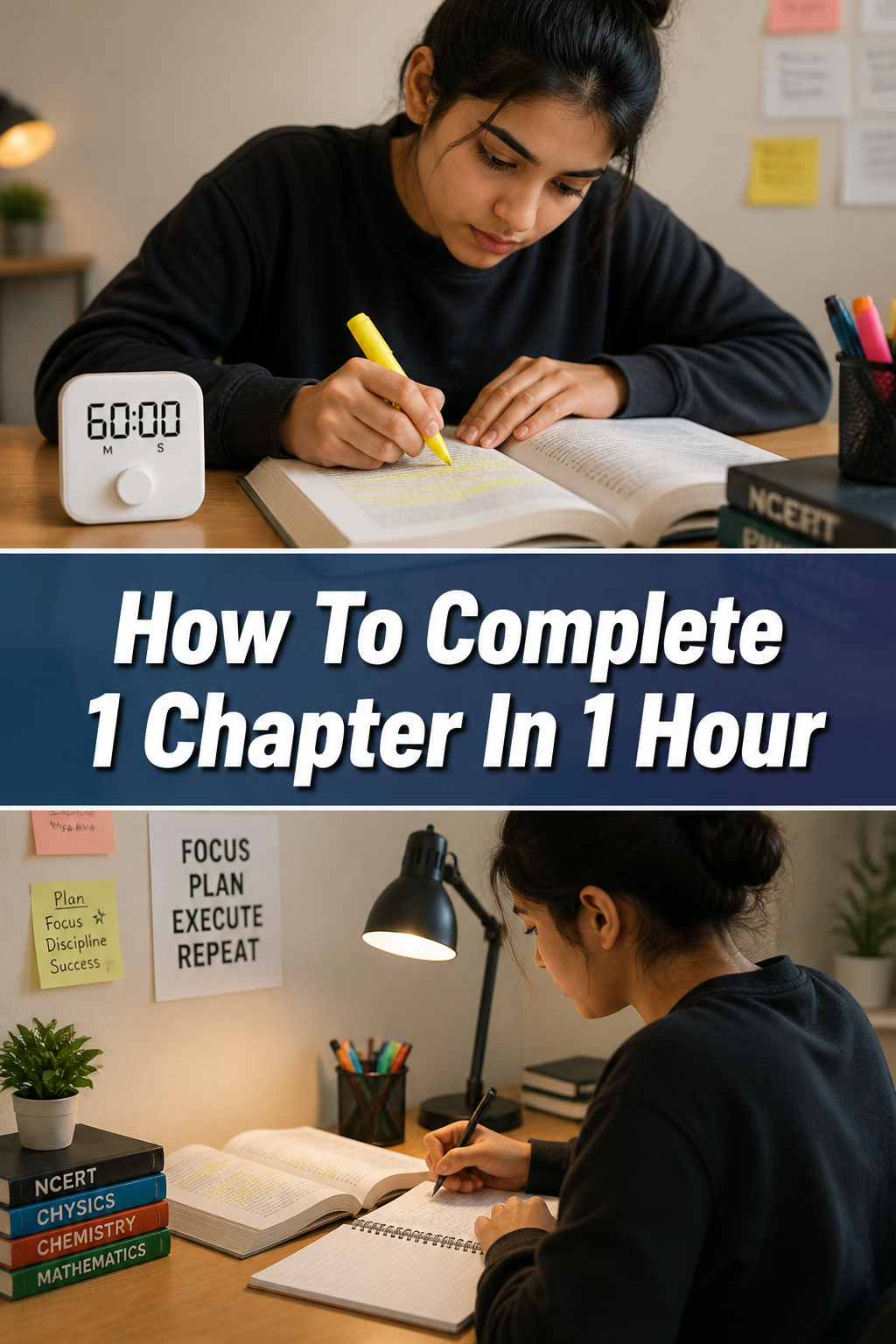
📚 How To Complete 1 Chapter In 1 Hour
Feeling overwhelmed by textbooks and long reading assignments? Many students struggle to get through dense material efficiently.
I’ve personally tested and refined this method over years of academic study, transforming hours of reading into focused, productive bursts.
This guide will equip you with the exact techniques to conquer any chapter, boosting your comprehension and saving valuable time.
Quick Overview
This guide provides a structured, actionable plan to process a chapter effectively within a tight timeframe. You will learn how to read strategically, identify key information, and retain core concepts.
- Time needed: Approximately 60 minutes, with potential for faster completion over time.
- Difficulty: Beginner to Intermediate. Basic reading skills are assumed; the techniques are easy to apply.
- What you’ll need: Your chapter, a pen/highlighter, a notebook or digital note-taking tool, and a timer.
Step-by-Step Instructions
Step 1: Set the Stage (5 minutes)
Before you even open the book, prepare your environment. A focused setting is critical for an intensive reading session.
Find a quiet space where you won’t be interrupted. Turn off notifications on your phone, close unnecessary browser tabs, and tell others you need uninterrupted time.
Gather all necessary materials: the textbook, a pen, a highlighter, and your notebook. Having everything within reach prevents distractions later.
Pro Tip: Use a simple kitchen timer or a dedicated app to track your time. Seeing the countdown can help maintain focus and urgency.
Step 2: Preview the Chapter (10 minutes)
Do not dive straight into the first paragraph. Begin by getting a high-level overview of the chapter’s structure and main ideas.
Scan the chapter title, introduction, and conclusion first. These sections often summarize the core arguments or topics covered.
Look at all headings, subheadings, and bolded terms. This provides a mental map of the chapter’s organization and key vocabulary.
Examine any images, charts, graphs, or tables. Read their captions carefully, as they often convey significant information visually.
Quickly read the first and last sentence of each paragraph. This technique, known as topic sentence scanning, helps you grasp the main point of each section without reading every word.
Step 3: Define Your Goal (2 minutes)
After your preview, clarify what you need to get from this chapter. Are you looking for specific facts, a general understanding, or to answer particular questions?
If your professor provided learning objectives or questions, write them down. These will guide your active reading.
Even without specific prompts, formulate one or two questions based on your preview. For example, “What are the three main theories discussed?” or “How does X relate to Y?”
Pro Tip: Writing down your goal transforms passive reading into active inquiry. It gives your brain a specific mission.
Step 4: Active Reading & Highlighting (25 minutes)
Now, read the chapter with your defined goal in mind. This is not a passive activity; you are actively engaging with the text.
Read at a brisk pace, but do not skim entire paragraphs. Focus on understanding the main idea of each section as you go.
Highlight only the most important information. Aim for no more than one sentence per paragraph, or only key phrases. Excessive highlighting is counterproductive.
Look for answers to the questions you defined in Step 3. If you find them, make a mental note or a quick mark in your notebook.
Pause briefly at the end of each major section. Mentally summarize what you just read before moving on to the next part.
Step 5: Minimalist Note-Taking (10 minutes)
As you read, or immediately after finishing a section, jot down concise notes. These notes should be extremely brief and focused.
Use bullet points, keywords, or short phrases. Avoid writing full sentences unless absolutely necessary for clarity.
Focus on capturing the main ideas, key definitions, and any relationships between concepts. Think of your notes as an outline of the chapter’s most important points.
If the chapter has specific questions at the end, try to answer them in your notes. This reinforces your understanding and highlights gaps.
Pro Tip: Try the “Cornell Notes” method in a simplified way. Divide your page into two columns: one for main points/questions and a smaller one for keywords/cues. This aids quick review.
Step 6: Quick Recap & Self-Test (8 minutes)
Once you’ve finished reading and note-taking, take a few minutes to consolidate your understanding. This step is crucial for retention.
Review your notes. Can you explain the main points of the chapter using only what you’ve written down?
Close your book and notes. Try to recall the chapter’s key themes, important terms, and major arguments from memory.
Answer the questions you set for yourself in Step 3. If you struggle with any, quickly refer back to your notes or the textbook for a brief clarification.
Mentally summarize the entire chapter in your own words. Imagine you are explaining it to someone else.
Common Mistakes to Avoid
Passive Reading
Many students simply let their eyes pass over the words without actively engaging. This leads to poor comprehension and quick forgetting.
Instead, approach the text with a purpose. Ask questions, look for answers, and consciously connect new information to what you already know.
Over-Highlighting Everything
Highlighting every other sentence makes your textbook look colorful but provides no real benefit. It prevents you from identifying what is truly important.
Be selective. Highlight only key terms, definitions, and main ideas. If you highlight too much, nothing stands out, defeating the purpose.
Skipping the Preview
Jumping directly into the first paragraph without understanding the chapter’s structure is like trying to navigate a new city without a map. You’ll get lost and waste time.
Always take those initial minutes to preview headings, introductions, and conclusions. This provides context and primes your brain for the information to come.
Multitasking
Trying to read while checking social media, watching TV, or chatting with friends guarantees a superficial understanding. Your brain cannot effectively process dense material while divided.
Commit to a distraction-free hour. Close all unnecessary tabs, put your phone away, and focus solely on the chapter. Deep work requires undivided attention.
Troubleshooting
“I Can’t Focus for a Full Hour”
It’s common to struggle with sustained concentration, especially when starting out. Your brain needs training to stay focused.
Try breaking the hour into smaller segments. Use the Pomodoro Technique: 25 minutes of focused work, followed by a 5-minute break. Adjust the segments as needed, gradually increasing your focus time.
“The Chapter Is Too Dense/Difficult”
Some chapters genuinely contain complex concepts or unfamiliar vocabulary. This can make the one-hour goal feel impossible.
Before starting, look up any critical unfamiliar terms in a glossary or online. If the chapter builds on prior knowledge, quickly review those foundational concepts first. Don’t be afraid to read a difficult paragraph twice, but don’t get stuck on it for too long.
“I Don’t Feel Like I Retained Anything”
A common feeling after speed-reading. Retention comes from active processing and review, not just reading.
Ensure you are truly engaging in Step 5 (Minimalist Note-Taking) and Step 6 (Quick Recap & Self-Test). Explaining the concepts aloud to yourself or a friend can significantly boost retention.
Key Takeaways
- Preparation and a focused environment are essential for efficient reading.
- Always preview a chapter to create a mental map and understand its structure.
- Define clear goals and questions before you begin reading to guide your attention.
- Practice active reading by highlighting sparingly and mentally summarizing sections.
- Take minimalist notes, focusing on keywords and main ideas, not full sentences.
- Conclude with a quick self-test and recap to reinforce learning and identify gaps.
Frequently Asked Questions
Is it possible to truly understand a chapter in an hour?
Yes, but “understanding” here means grasping the main concepts, key arguments, and overall structure. It’s not about memorizing every detail. For deeper memorization, subsequent review sessions are necessary, but this method provides a solid foundation.
What if the chapter is exceptionally long or complex?
For very long or highly complex chapters, you might need to adjust the goal. Consider breaking the chapter into two or more one-hour sessions, focusing on distinct sections. The principles of previewing, active reading, and note-taking still apply, just over a longer total duration.
Can I use this method for fiction or pleasure reading?
While the techniques of previewing and active engagement can be adapted, this guide is optimized for academic and informational texts. For pleasure reading, the goal is often immersion and enjoyment, not rapid information extraction, so a different approach might be preferred.
How can I improve my reading speed?
Consistent practice with active reading techniques helps. Additionally, try to reduce subvocalization (reading words aloud in your head) and expand your eye span (reading more words at once). There are also specific speed-reading exercises and apps available if you want to dedicate time to that skill.
Our Top Recommended Finds
- Digital Timer: A simple, easy-to-use digital timer helps you stay on track with your allocated time for each step.
- Dedicated Notebook: A clean, college-ruled notebook for your minimalist notes keeps your thoughts organized and separate from the textbook itself.
- Quality Highlighters (2 colors): Using two different colors (e.g., one for main ideas, one for definitions) can help you quickly distinguish between types of information during review.
Transform Your Study Habits Today
Applying these techniques will fundamentally change how you approach your reading assignments. You’ll move from passive page-turning to active, purposeful engagement.
Imagine the confidence of knowing you can tackle any chapter, no matter how daunting it seems, in a focused hour.
Don’t just read about these strategies; implement them in your next study session. Start with a chapter that feels manageable, and build your momentum.
Ready to reclaim your study time and boost your academic performance? The first step is to apply what you’ve learned here, right now.