✍️ How To Write A Story Step By Step
Everyone has a story inside them waiting to be told.
I remember sitting at my desk years ago, staring at a blank screen and feeling completely overwhelmed by the infinite possibilities of a first sentence.
After finishing several novels and dozens of short stories, I realized that writing isn’t about magic inspiration, but a repeatable process that anyone can master.
Quick Overview
This guide will take you from a vague idea to a completed, polished narrative through a series of manageable actions.
- Time needed: 2 to 6 months (depending on length)
- Difficulty: Beginner
- What you’ll need: A notebook or word processor, a quiet space, and persistence.
Step-by-Step Instructions
Step 1: Capture Your Initial Spark
Every great narrative begins with a single “What If” question that refuses to leave your mind.
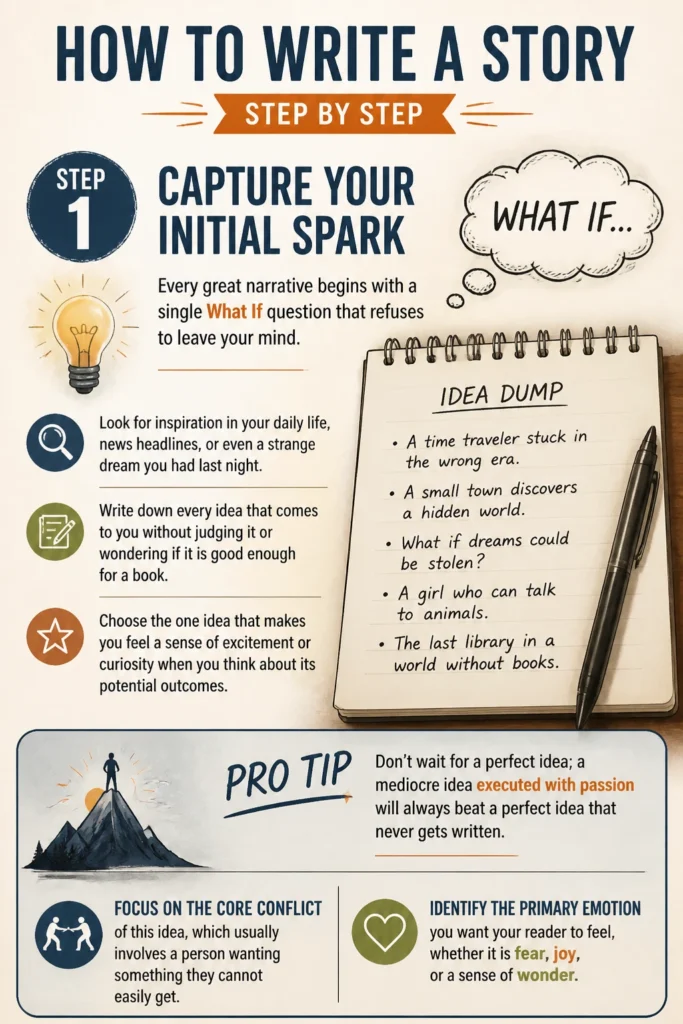
Look for inspiration in your daily life, news headlines, or even a strange dream you had last night.
Write down every idea that comes to you without judging it or wondering if it is “good enough” for a book.
Choose the one idea that makes you feel a sense of excitement or curiosity when you think about its potential outcomes.
Pro Tip: Don’t wait for a perfect idea; a mediocre idea executed with passion will always beat a “perfect” idea that never gets written.
Focus on the core conflict of this idea, which usually involves a person wanting something they cannot easily get.
Identify the primary emotion you want your reader to feel, whether it is fear, joy, or a sense of wonder.
Step 2: Build a Relatable Protagonist
Readers do not follow plots; they follow people who are going through difficult experiences.

Give your character a specific “Want,” which is an external goal like winning a race or finding a lost treasure.
Assign them a “Need,” which is an internal emotional requirement like learning to trust others or finding self-worth.
Create a flaw that prevents them from achieving their goal immediately, making their journey feel earned and realistic.
Develop a brief backstory that explains why they behave the way they do in the present moment.
Pro Tip: Your character should be proactive; they must make choices that drive the story forward rather than just reacting to things that happen to them.
Think about their physical appearance, but focus more on their unique voice and how they view the world.
Step 3: Establish High Stakes
If nothing is at risk, the reader will have no reason to keep turning the pages of your story.

Determine what will happen if the protagonist fails to reach their goal by the end of the narrative.
Increase the pressure by making the consequences personal, such as losing a relationship or a sense of identity.
Ensure the stakes are clear to the reader within the first few chapters so they understand why the journey matters.
Introduce an antagonist or an opposing force that is just as motivated as your hero to succeed.
Step 4: Design the World and Atmosphere
The setting of your story should feel like a living character rather than just a backdrop for the action.

Select a location that complements the themes of your story, such as a claustrophobic city or a vast, lonely desert.
Use sensory details to describe the environment, focusing on smells, sounds, and textures rather than just visual descriptions.
Establish the “rules” of your world early on, especially if you are writing fantasy or science fiction.
Consider how the environment affects your protagonist’s mood and their ability to solve problems.
Pro Tip: Only include setting details that serve the story or reveal something about the character’s state of mind.
Step 5: Outline the Major Plot Points
A basic structure helps you stay on track and prevents the middle of your story from becoming aimless.

Map out the Inciting Incident, which is the specific event that forces the character out of their normal life.
Identify the First Plot Point, where the character commits fully to the journey and there is no turning back.
Plan the Midpoint, a major shift where the protagonist stops being a victim of circumstances and starts taking control.
Visualize the Climax, the final confrontation where the hero must face their greatest fear to succeed.
Decide on the Resolution, showing the “new normal” for the characters after the conflict has been settled.
Step 6: Choose Your Point of View
The perspective you choose determines how much information the reader has and how close they feel to the character.

Try first-person (“I”) if you want an intimate, immediate connection between the reader and the protagonist.
Opt for third-person limited (“He/She”) if you want to stay close to one character but maintain a bit of narrative distance.
Select third-person omniscient if you need to show the thoughts and feelings of multiple characters across different locations.
Stay consistent with your chosen perspective throughout the entire draft to avoid confusing the reader.
Step 7: Write the First Draft
This is the stage where you simply get the words down on paper without worrying about quality.

Set a daily word count goal to maintain momentum and build a consistent writing habit.
Ignore your “inner critic” that tells you the writing is bad or the dialogue sounds forced.
Leave placeholders like “[INSERT SCENE HERE]” if you get stuck on a specific part so you can keep moving forward.
Focus on finishing the story from beginning to end before you allow yourself to go back and change anything.
Pro Tip: You cannot fix a blank page; a finished “bad” draft is infinitely more valuable than a perfect first chapter.
Step 8: Revise and Polish
Writing is actually rewriting, and this is where the real magic of storytelling happens.

Step away from your manuscript for at least two weeks after finishing the first draft to gain a fresh perspective.
Read the entire story through once and look for “big picture” issues like plot holes or inconsistent character behavior.
Cut scenes that do not move the plot forward or reveal something essential about the characters.
Tighten your prose by removing unnecessary adverbs and replacing weak verbs with stronger, more descriptive ones.
Read your dialogue out loud to ensure it sounds natural and reflects the unique voice of each character.
Common Mistakes to Avoid
The Information Dump
Many writers feel the need to explain every detail of their world’s history or a character’s past in the first few pages. This stops the momentum of the story and bores the reader before the action even starts.
Instead of explaining, try to weave details into the action and dialogue naturally. Only share information when the reader absolutely needs to know it to understand what is happening in the moment.
The Passive Protagonist
A story becomes dull when the main character simply lets things happen to them or waits for others to save the day. Readers want to see a hero who makes difficult choices and faces the consequences of those decisions.
Ensure your protagonist is the one driving the plot forward through their own desires and actions. If a secondary character is solving all the problems, you might need to rethink who your main character actually is.
Weak or Non-Existent Stakes
If the protagonist can simply walk away from the conflict without any negative consequences, the reader will lose interest. There must be a compelling reason why the character has to stay in the fight.
Make the stakes matter on both a physical and emotional level. If they fail, they shouldn’t just lose a prize; they should lose something that defines who they are.
Troubleshooting
Writer’s Block
When you feel stuck and don’t know what happens next, it usually means you haven’t made things difficult enough for your character. Ask yourself, “What is the worst thing that could happen to my character right now?”
Once you identify that disaster, write the scene where it happens. Pushing your character into a corner often reveals the path forward and reignites your creative energy.
The Sagging Middle
It is common for the middle of a story to feel slow or aimless after the initial excitement of the beginning wears off. This usually happens because the protagonist is “treading water” instead of making progress toward their goal.
To fix this, introduce a new subplot or a surprising twist that raises the stakes even higher. Force your character to change their strategy or face a setback that makes their ultimate goal seem impossible.
Flat Characters
If your characters feel like cardboard cutouts, they probably lack internal conflict or contradictory traits. Real people are messy and often want two things that are in direct opposition to each other.
Give your character a secret they are afraid to share or a belief that is proven wrong by the events of the story. These layers make them feel human and keep the reader invested in their personal growth.
Key Takeaways
- Start with a compelling “What If” question that explores a central conflict.
- Create a protagonist with both an external want and an internal need.
- Ensure the stakes are high enough that the character cannot simply walk away.
- Use a basic plot structure to keep the narrative moving toward a satisfying climax.
- Focus on finishing the first draft completely before starting the revision process.
- Revise for both structural integrity and word-level clarity to produce a professional result.
Frequently Asked Questions
How long should my story be?
The length depends entirely on the type of story you are telling. Short stories are usually between 1,000 and 7,500 words, while novels typically start at 50,000 words. Focus on telling the story in as many words as it needs to be effective, rather than hitting a specific number.
Do I need to outline before I start writing?
Some writers prefer to plan every detail (Plotters), while others prefer to discover the story as they go (Pantsers). Neither way is wrong, but having a basic idea of your ending can help prevent you from getting lost in the middle of the draft.
What if my idea feels too similar to an existing book?
There are no truly original ideas, only original executions. Your unique voice, life experiences, and perspective will make the story yours, even if the basic premise has been explored by other authors before.
How do I know when my story is finished?
A story is finished when the central conflict is resolved and the protagonist has undergone a meaningful change. If you find yourself making tiny changes to punctuation without improving the story itself, it is likely time to stop editing and share your work.
Our Top Recommended Finds
- A High-Quality Journal: Using a physical notebook for brainstorming and character sketches helps separate the “creative” phase from the “typing” phase.
- Scrivener Software: This tool is excellent for organizing long-form projects, allowing you to keep your research, outlines, and drafts in one place.
- Noise-Canceling Headphones: Creating a focused environment is vital for deep work, and these help block out distractions during your daily writing sessions.
Start Your Creative Journey Today
Writing a story is a marathon, not a sprint, and the most important step is simply showing up to the page.
You now have the framework to transform your ideas into a structured and engaging narrative.
Pick up your pen or open a new document right now and write down one “What If” question that has been lingering in your mind.
Once you have that spark, the rest of the steps are just a matter of consistent effort and heart.
If you enjoyed this guide, you might also want to look into techniques for writing realistic dialogue or tips for building immersive fictional worlds.