✍️ How To Start A Story Ideas Writing
I spent years waiting for a single, perfect lightning bolt of inspiration to strike my keyboard.
I believed that real writers simply sat down and watched a masterpiece unfold from their fingertips.
Eventually, I realized that waiting is a trap, and the best stories are actually built from small, intentional sparks.

Quick Overview
This guide shows you how to move from a blank page to a list of compelling story concepts using repeatable techniques.
- Time needed: 30 to 60 minutes
- Difficulty: Beginner
- What you’ll need: A notebook or digital document, a timer, and an open mind.
Step-by-Step Instructions
Step 1: Practice Active Observation
Look at the world around you as if you are a detective searching for clues.
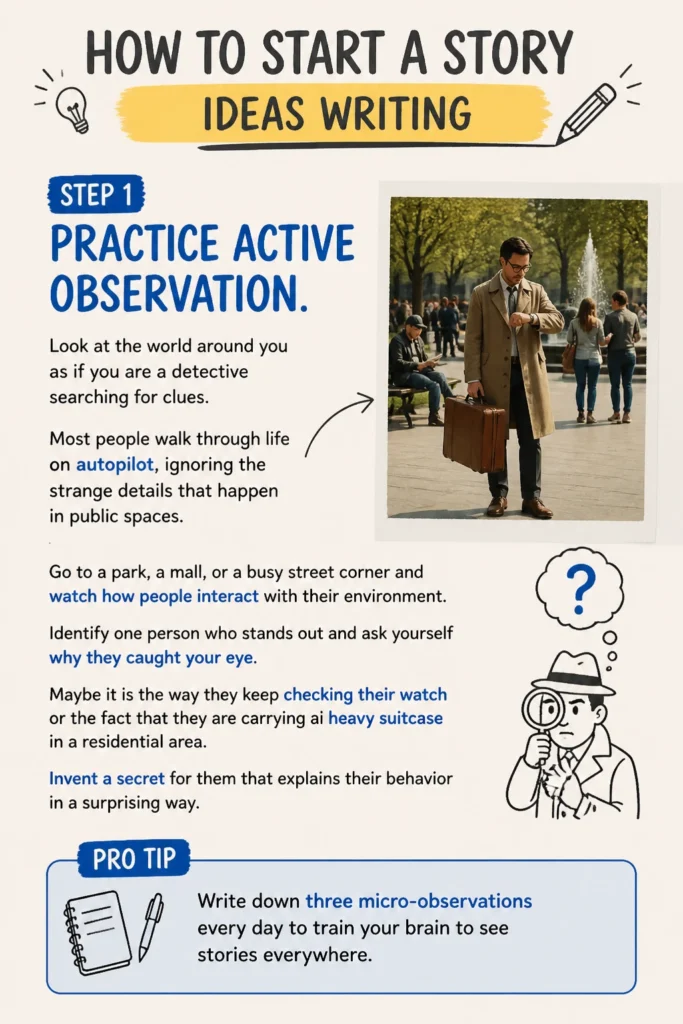
Most people walk through life on autopilot, ignoring the strange details that happen in public spaces.
Go to a park, a mall, or a busy street corner and watch how people interact with their environment.
Identify one person who stands out and ask yourself why they caught your eye.
Maybe it is the way they keep checking their watch or the fact that they are carrying a heavy suitcase in a residential area.
Invent a secret for them that explains their behavior in a surprising way.
Pro Tip: Write down three “micro-observations” every day to train your brain to see stories everywhere.
Step 2: Apply the “What If” Method
Take a normal, everyday situation and introduce one impossible or extreme element.
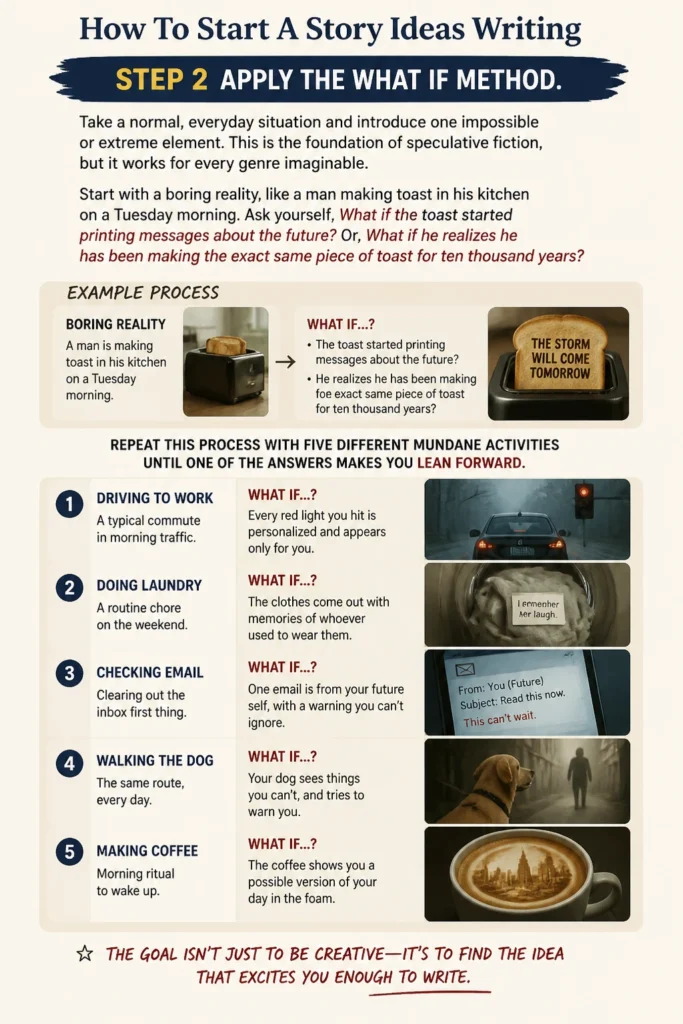
This is the foundation of speculative fiction, but it works for every genre imaginable.
Start with a boring reality, like a man making toast in his kitchen on a Tuesday morning.
Ask yourself, “What if the toast started printing messages about the future?”
Or, “What if he realizes he has been making the exact same piece of toast for ten thousand years?”
Repeat this process with five different mundane activities until one of the answers makes you lean forward.
Step 3: Combine Conflicting Concepts
Merge two ideas that usually do not belong together to create immediate tension.
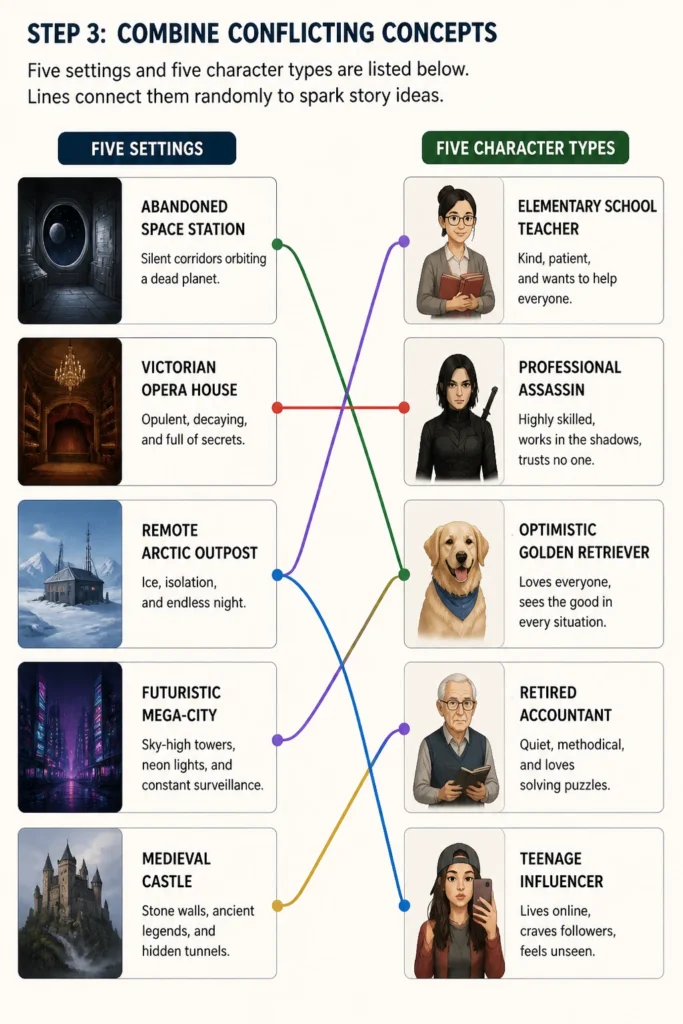
Think about a high-stakes setting and pair it with a low-stakes character or vice versa.
A professional assassin who is terrified of spiders creates an instant internal conflict.
Try blending genres, such as a gritty police procedural set in a world where everyone is a ghost.
Contrast is the engine of interest because it forces the reader to wonder how those two things coexist.
Write a list of five settings and five character types, then draw lines to connect them randomly.
Step 4: Mine Your Personal History
Recall a moment in your life when you felt a very strong, specific emotion.
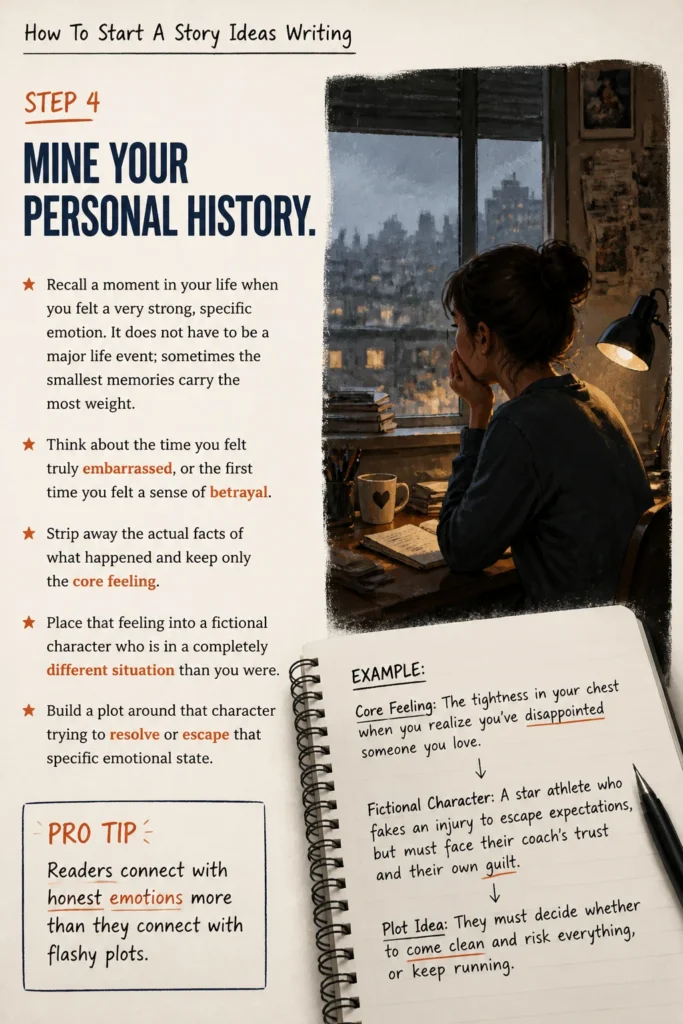
It does not have to be a major life event; sometimes the smallest memories carry the most weight.
Think about the time you felt truly embarrassed, or the first time you felt a sense of betrayal.
Strip away the actual facts of what happened and keep only the core feeling.
Place that feeling into a fictional character who is in a completely different situation than you were.
Build a plot around that character trying to resolve or escape that specific emotional state.
Pro Tip: Readers connect with honest emotions more than they connect with flashy plots.
Step 5: Use Sensory Prompts
Choose a specific smell, sound, or texture to serve as the anchor for a new scene.
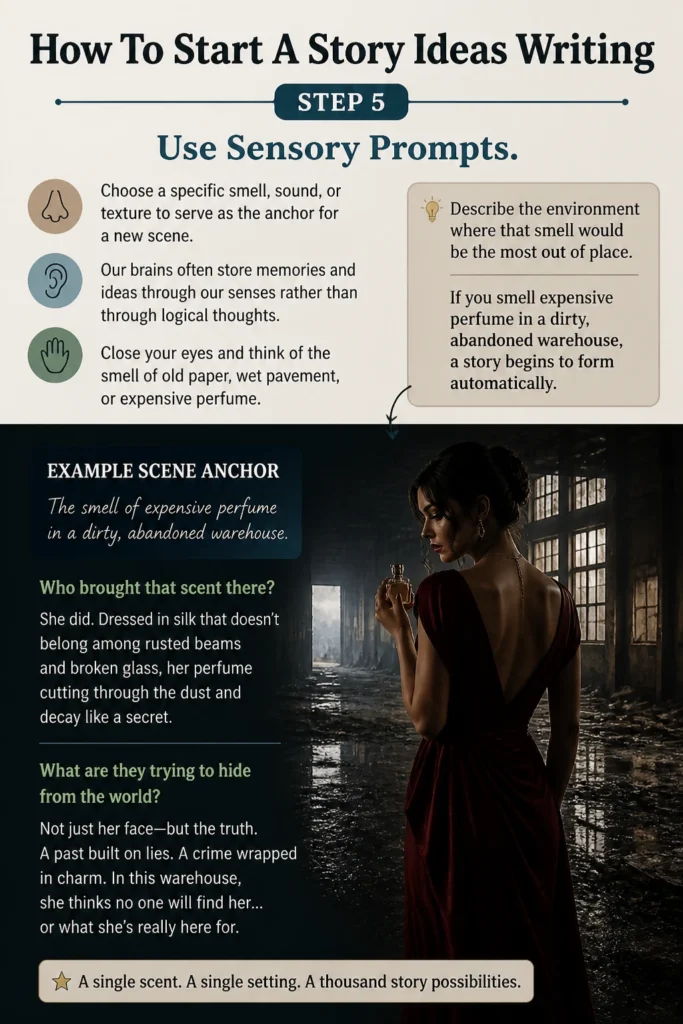
Our brains often store memories and ideas through our senses rather than through logical thoughts.
Close your eyes and think of the smell of old paper, wet pavement, or expensive perfume.
Describe the environment where that smell would be the most out of place.
If you smell expensive perfume in a dirty, abandoned warehouse, a story begins to form automatically.
Explain who brought that scent there and what they are trying to hide from the world.
Step 6: Explore the “Why” of News Headlines
Find a strange or unusual news story from a local paper or an online “weird news” section.
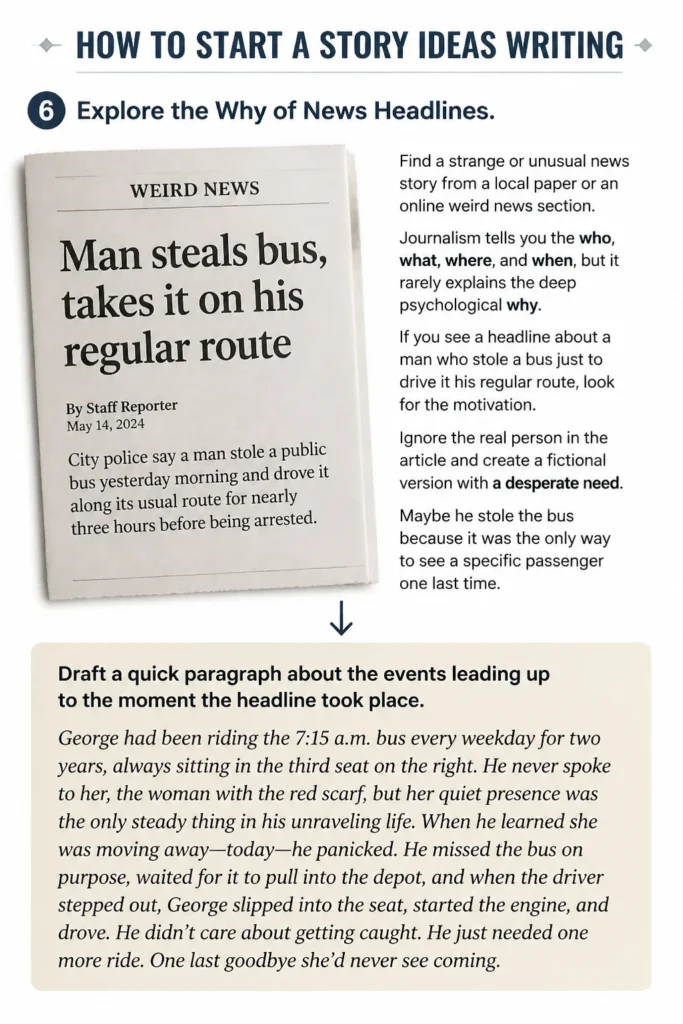
Journalism tells you the who, what, where, and when, but it rarely explains the deep psychological “why.”
If you see a headline about a man who stole a bus just to drive it his regular route, look for the motivation.
Ignore the real person in the article and create a fictional version with a desperate need.
Maybe he stole the bus because it was the only way to see a specific passenger one last time.
Draft a quick paragraph about the events leading up to the moment the headline took place.
Step 7: Build a Character Through Desire
Create a character by deciding on one thing they want more than anything else in the world.
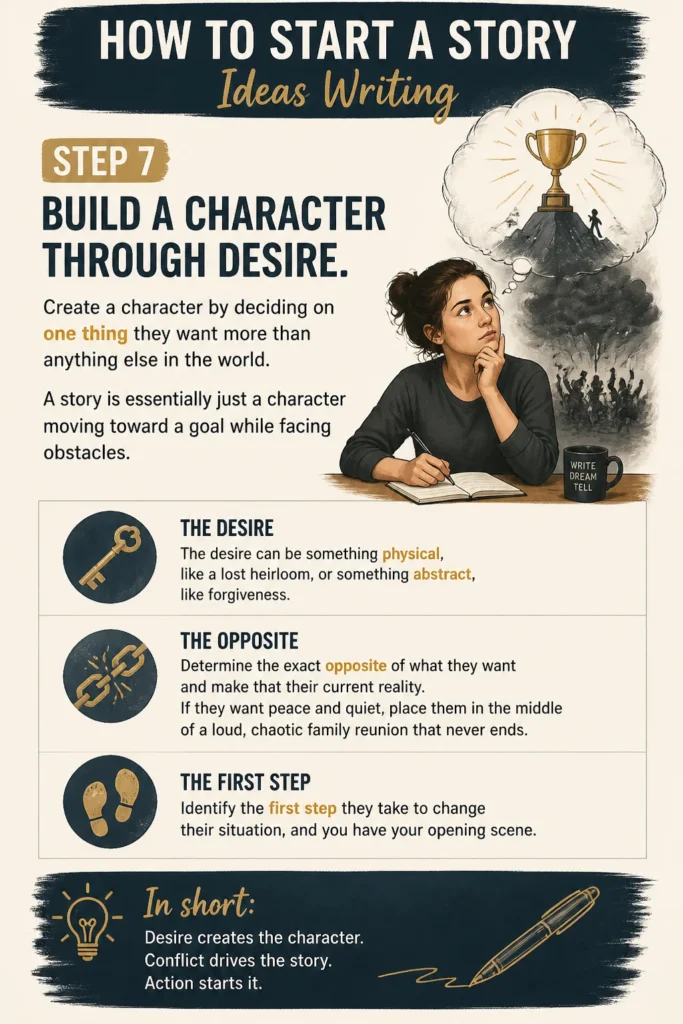
A story is essentially just a character moving toward a goal while facing obstacles.
The desire can be something physical, like a lost heirloom, or something abstract, like forgiveness.
Determine the exact opposite of what they want and make that their current reality.
If they want peace and quiet, place them in the middle of a loud, chaotic family reunion that never ends.
Identify the first step they take to change their situation, and you have your opening scene.
Step 8: Set a “Bad Idea” Timer
Set a timer for ten minutes and force yourself to write down as many story ideas as possible.
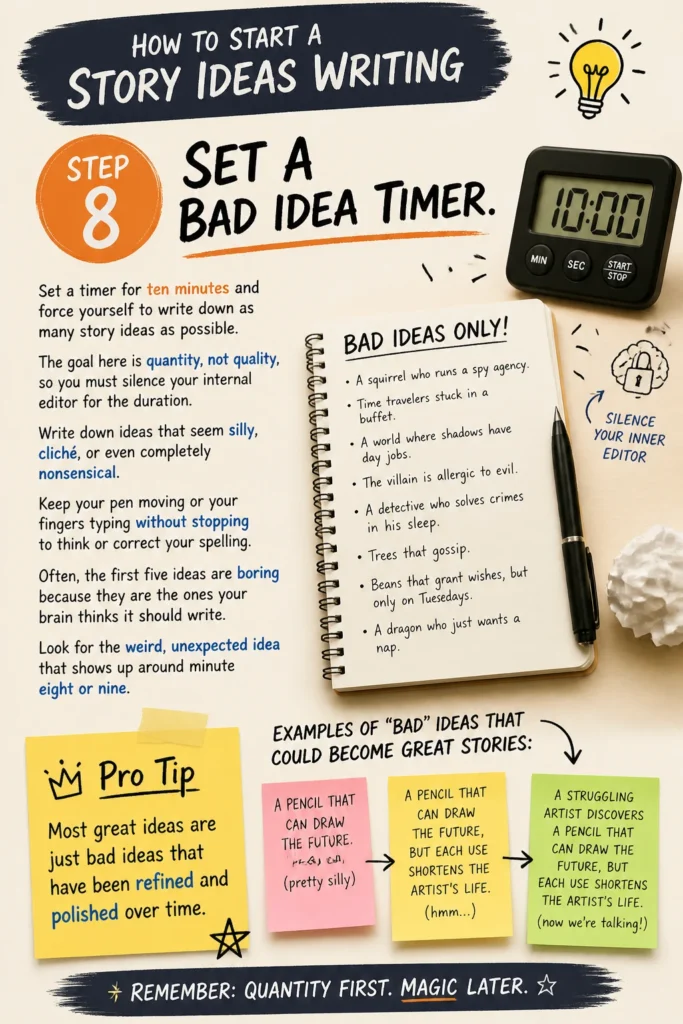
The goal here is quantity, not quality, so you must silence your internal editor for the duration.
Write down ideas that seem silly, cliché, or even completely nonsensical.
Keep your pen moving or your fingers typing without stopping to think or correct your spelling.
Often, the first five ideas are boring because they are the ones your brain thinks it “should” write.
Look for the weird, unexpected idea that shows up around minute eight or nine.
Pro Tip: Most great ideas are just “bad” ideas that have been refined and polished over time.
Common Mistakes to Avoid
Waiting for Perfect Inspiration
Many writers believe they cannot start until they have a fully formed plot from beginning to end.
This approach leads to procrastination and a permanent state of “thinking about writing” instead of actually doing it.
The truth is that most stories reveal themselves while you are working on them, not before you start.
Accept that your initial idea will be messy and incomplete, and trust the process of discovery.
Overcomplicating the Initial Concept
It is easy to get bogged down in world-building, magic systems, or complex backstories before you have a story.
If you spend weeks designing a map but have no characters with problems, you don’t have a story idea yet.
Keep your starting point simple: one person, one problem, and one setting.
You can add the layers of complexity later once the heart of the story is beating on its own.
Ignoring the Element of Conflict
A common mistake is coming up with a “situation” rather than a “story idea.”
A situation is “a girl goes to a coffee shop,” while a story idea is “a girl goes to a coffee shop and sees her own obituary in the newspaper.”
Without a problem to solve or a hurdle to jump, the reader has no reason to keep turning the page.
Always ask yourself what is stopping your character from getting what they want right now.
Troubleshooting
The “Nothing is Original” Anxiety
You might feel discouraged because your idea seems similar to a book or movie you have already seen.
Every story has already been told in some form, but it has not been told through your unique perspective.
Take the “unoriginal” idea and change the setting, the gender of the lead, or the final outcome.
Your voice and your specific life experiences will naturally make the concept feel fresh and new.
The Middle-of-the-Idea Slump
Sometimes you have a great beginning and a great ending but have no idea how to connect them.
Instead of trying to bridge the gap linearly, work backward from your ending one step at a time.
Ask what had to happen immediately before the finale to make that ending possible.
Keep tracing the steps back until you meet the beginning of the story in the middle.
Too Many Ideas at Once
Having too many ideas can be just as paralyzing as having none at all because you fear picking the “wrong” one.
Pick the idea that feels the most uncomfortable or the one that you can’t stop thinking about when you try to sleep.
The idea that scares you or makes you feel a little vulnerable is usually the one with the most potential.
Commit to one idea for a week; if it doesn’t grow, you can always go back to your list and pick another.
Key Takeaways
- Story ideas are built, not found, through consistent observation and intentional creative exercises.
- Use “What If” questions to turn boring, everyday moments into high-stakes fictional scenarios.
- Focus on character desire and conflict to ensure your idea has enough momentum to become a full story.
- Quantity leads to quality, so use timed brainstorming sessions to bypass your inner critic.
- Don’t wait for perfection before you start writing; the best parts of an idea often emerge during the draft.
- Leverage your own emotions to give your fictional concepts a sense of truth and resonance.
Frequently Asked Questions
How do I know if a story idea is actually good?
A good idea is one that stays in your mind for more than a few days and makes you want to ask more questions.
If you find yourself wondering “what happens next” even when you aren’t at your desk, the idea has legs.
Ultimately, a good idea is simply one that you are excited enough to spend weeks or months working on.
Should I write down every idea I have?
Yes, because the human brain is excellent at coming up with ideas but terrible at storing them long-term.
Keep a digital note on your phone or a small notebook in your pocket to capture fragments as they arrive.
Even if an idea seems useless now, it might be the missing piece of a different story a year from today.
What if I start an idea and realize it isn’t working?
This is a normal part of the creative process and does not mean you are a bad writer or that the idea is “bad.”
Try changing the point of view or the tense of the story to see if a different perspective fixes the issue.
If it still feels flat, put it in a “scrap” folder and move on to the next concept on your list.
Can I use story prompts found online?
Prompts are excellent tools for warming up your creative muscles and getting the words flowing.
However, try to put your own twist on the prompt so it feels like it belongs to you rather than the person who wrote it.
Use the prompt as a jumping-off point rather than a rigid set of instructions you have to follow.
Our Top Recommended Finds
- A Pocket-Sized Notebook: Choose one with a durable cover that you can take anywhere without worrying about it getting damaged.
- A High-Quality Fineliner Pen: Using a pen that feels good in your hand can make the physical act of brainstorming more enjoyable.
- A Digital Voice Recorder: This is perfect for capturing ideas while driving or walking when you cannot safely stop to write.
Transform Your Inspiration Into Action
The hardest part of any creative project is moving from the abstract thought to the concrete word.
Now that you have these tools, pick one of the steps above and spend the next ten minutes using it.
Don’t worry about whether the result is “publishable” or “perfect” right now.
Focus on the curiosity of the process and the joy of asking “what if” without any consequences.
Once you have a list of three solid concepts, choose the one that makes you the most curious and write the first paragraph today.