
📖 How To Take Notes In Your Bible
For years, my Bible remained pristine, untouched by pen or highlighter. I feared “ruining” its sacred pages. Yet, I soon realized that interacting with the text deepened my understanding and connection with God’s Word.
This guide will show you how to transform your Bible into a living journal of faith. It’s about personalizing your study and making the Scriptures truly your own.

Quick Overview
Taking notes in your Bible helps you engage deeply with the text, retain information, and track your spiritual growth. This guide will walk you through practical methods to effectively mark and annotate your Bible.
- Time needed: 30-60 minutes for initial setup, 5-15 minutes per study session
- Difficulty: Beginner
- What you’ll need: A Bible (preferably with wide margins), fine-tip pens, highlighters, a notebook (optional)
Step-by-Step Instructions
Step 1: Choose Your Bible Wisely
Not all Bibles are created equal for note-taking. Your choice can significantly impact your experience and the amount of space you have. Consider the physical attributes that best suit your goals.
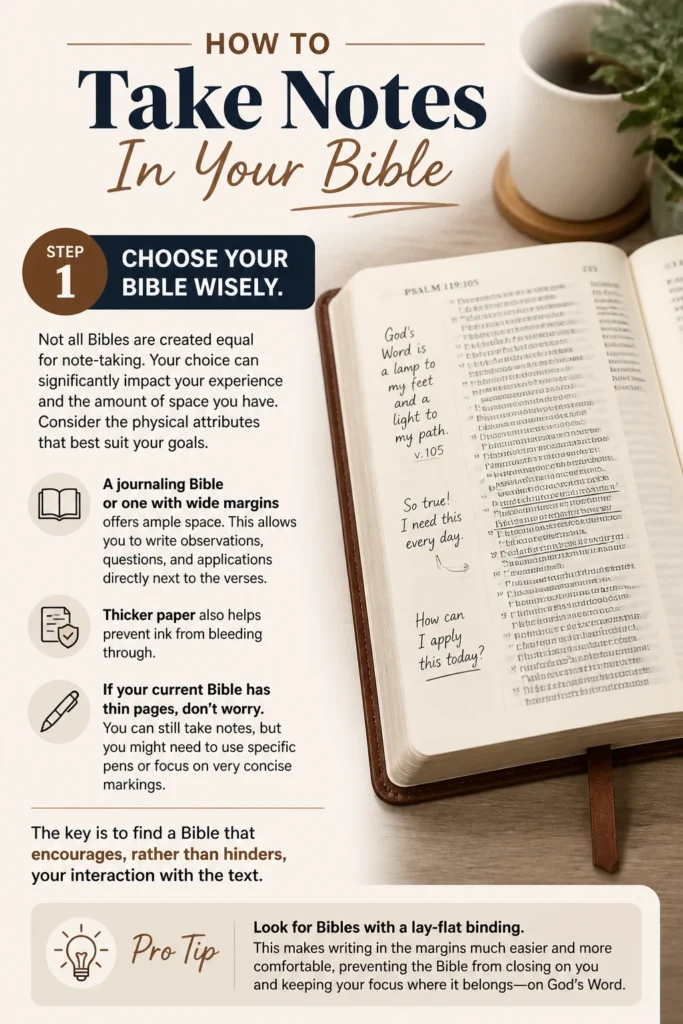
A journaling Bible or one with wide margins offers ample space. This allows you to write observations, questions, and applications directly next to the verses. Thicker paper also helps prevent ink from bleeding through.
If your current Bible has thin pages, don’t worry. You can still take notes, but you might need to use specific pens or focus on very concise markings. The key is to find a Bible that encourages, rather than hinders, your interaction with the text.
Pro Tip: Look for Bibles with a lay-flat binding. This makes writing in the margins much easier and more comfortable, preventing the book from closing on you mid-thought.
Step 2: Gather Your Essential Tools
The right tools make note-taking a joy, not a chore. Investing in quality supplies will protect your Bible and enhance your study time. Prioritize items that are non-bleed and designed for thin paper.

Start with a set of fine-tip, archival-quality pens. Pigma Micron pens or gel pens specifically designed for Bible journaling are excellent choices. They provide crisp lines without seeping through the pages.
Next, select highlighters that won’t bleed. Gel highlighters are fantastic for this purpose, as are some dry highlighters or colored pencils. Avoid traditional liquid highlighters, which often cause bleed-through and smudging.
You might also consider a ruler for drawing straight lines or a small set of colored pencils for adding subtle accents. These tools help create a visually organized and engaging study experience.
Step 3: Define Your Purpose for Note-Taking
Before you make your first mark, understand why you are taking notes. Your purpose will guide what you write and how you organize it. Are you studying for personal growth, sermon preparation, or group discussion?

Perhaps your goal is to simply record insights from daily devotions. Maybe you want to track themes, difficult passages, or answered prayers. Clearly defining your purpose provides focus and direction.
This clarity prevents overwhelming yourself with too much information. It helps you prioritize what to mark and what to leave for a separate notebook. Your Bible notes should serve your spiritual journey.
Step 4: Develop a Simple System or Key
A consistent system brings order to your notes. It allows you to quickly understand what different marks or colors signify. You don’t need anything overly complex; simplicity is often best.

Consider using a color-coding system for different themes. For example, yellow for God’s promises, blue for commands, green for applications, or pink for insights about Jesus. Choose colors that resonate with you.
You can also use simple symbols. A question mark for things you want to research, an exclamation point for impactful verses, or a small cross for verses about salvation. Keep a small key written on the inside cover of your Bible for quick reference.
This system helps categorize your thoughts at a glance. It turns your Bible into a personalized reference guide, making it easier to revisit and recall specific types of information.
Step 5: Engage Deeply with the Text
Note-taking is not just about marking; it’s about active engagement. Before you pick up your pen, truly immerse yourself in the Scripture. Read the passage multiple times, slowly and thoughtfully.

Pray for understanding and discernment. Ask the Holy Spirit to reveal truths to you. Consider the context: Who wrote it? To whom? What was happening historically?
Look for key words, repeated phrases, and central themes. Identify any commands, promises, warnings, or questions. This deep engagement forms the foundation for meaningful notes.
Only after this thoughtful process should you begin to mark. Your notes will then be a reflection of genuine interaction, not just superficial highlighting.
Step 6: Mark and Highlight Strategically
Less is often more when it comes to marking. The goal is to highlight what’s important, not to color every page. Strategic marking draws your eye to key insights without creating visual clutter.

Use your highlighters to emphasize main ideas or verses that particularly speak to you. Don’t highlight entire paragraphs; focus on phrases or sentences that carry significant weight.
Underline key words or concepts that stand out. You can use different colored pens for underlining to align with your color-coding system. This helps to break down the text into manageable insights.
Remember, your markings are personal. They are meant to guide your eye and jog your memory, not to be a comprehensive encyclopedia of everything in the text.
Step 7: Write Concise Margin Notes
The margins are your personal canvas for deeper reflection. Use this space to record your thoughts, questions, and applications. Keep your notes brief and to the point.

Write down observations about the text: What did you notice that you hadn’t before? Jot down questions that arise, prompting further study. Record cross-references to other relevant verses.
Most importantly, write personal applications. How does this verse apply to your life today? What action should you take? What prayer does it inspire? These applications make the Word living and active for you.
Pro Tip: If you run out of margin space, use a sticky note flag. You can write longer thoughts on the flag and attach it to the relevant page, keeping your Bible pages clean.
Step 8: Connect and Cross-Reference
The Bible is a unified story. Connecting passages enriches your understanding of the whole. Use your notes to build a web of interconnected truths.
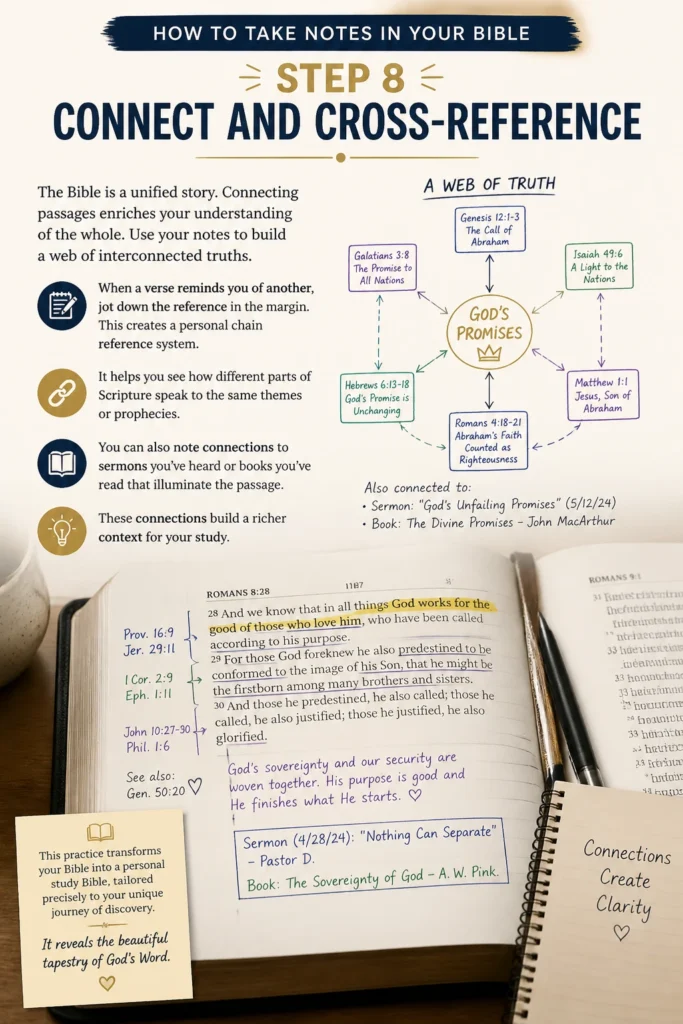
When a verse reminds you of another, jot down the reference in the margin. This creates a personal chain reference system. It helps you see how different parts of Scripture speak to the same themes or prophecies.
You can also note connections to sermons you’ve heard or books you’ve read that illuminate the passage. These connections build a richer context for your study.
This practice transforms your Bible into a personal study Bible, tailored precisely to your unique journey of discovery. It reveals the beautiful tapestry of God’s Word.
Step 9: Review and Reflect Regularly
Your notes are not just for the moment; they are for ongoing reflection. Regularly revisiting your marked Bible enhances retention and deepens your spiritual growth.

Take time to flip through previous notes. Reread your applications and prayers. See how your understanding has grown or how God has answered those prayers.
This review process reinforces what you’ve learned. It also provides a tangible record of your journey with God, reminding you of His faithfulness and your own progress in faith.
Your Bible becomes a living testimony, a testament to your personal walk with the Lord. It’s a powerful tool for remembrance and encouragement.
Common Mistakes to Avoid
Over-Marking and Excessive Highlighting
A common pitfall is trying to highlight or underline too much. When every sentence is marked, nothing truly stands out. This can make the page look cluttered and overwhelming, defeating the purpose of highlighting key insights.
Instead, be selective. Focus on the most impactful phrases, key words, or central ideas. The goal is to draw your eye to what is truly essential, not to color the entire page. Less marking often leads to greater clarity and impact.
Fear of “Ruining” Your Bible
Many people hesitate to mark their Bible because they fear damaging a sacred text. They worry about making mistakes or devaluing the book. This fear can prevent genuine interaction and personal engagement with Scripture.
Remember, your Bible is a tool for spiritual growth. Marking it with your insights, questions, and prayers transforms it into a living record of your faith journey. It’s not about desecration, but about deeper personal connection. Embrace the process; your Bible is meant to be used.
Lack of a Consistent System
Starting to mark without any system can lead to confusion later on. If you use different colors or symbols inconsistently, you might forget what they mean. This makes your notes less effective for review and recall.
Before you begin, establish a simple color code or symbol key. Stick to it. Even a basic system, like one color for promises and another for commands, will make your notes much more useful over time. Consistency is key to clarity.
Copying Others’ Notes Without Personal Engagement
It’s easy to be influenced by others’ markings or pre-printed study notes. While external resources are valuable for understanding, simply copying them without personal reflection diminishes the benefit. Your notes should be your insights.
Engage with the text yourself. Ask your questions, record your observations, and write your applications. Use external resources to inform your understanding, but let your notes reflect your unique interaction with God’s Word. Personal ownership deepens the learning.
Troubleshooting
Running Out of Margin Space
It’s common to find yourself with more thoughts than available space. This can be frustrating when you want to capture every insight. Don’t let limited space deter your note-taking.
Consider using transparent sticky note flags or small sticky notes. You can write longer thoughts on these and place them directly on the page, extending your writing area. Alternatively, keep a dedicated Bible study journal where you can expand on your thoughts and simply reference the page number in your Bible’s margin.
Feeling Overwhelmed or Not Knowing What to Write
Sometimes, the sheer volume of information or the depth of a passage can feel daunting. You might stare at the page, unsure of where to start or what is important enough to write down. This is a normal part of the process.
Begin by asking simple questions: What stood out to me in this passage? Is there a command, a promise, or a warning? How does this apply to my life today? Start with just one observation or one question. Over time, you’ll develop a rhythm and confidence in what to record.
Ink Smudging or Bleeding Through Pages
This is a common issue, especially with thinner Bible paper. Smudged or bled-through ink can make your notes messy and obscure the text. The wrong tools are usually the culprit.
Ensure you are using fine-tip, archival-quality pens that are specifically designed for thin paper, like Pigma Microns or certain gel pens. For highlighting, switch to gel highlighters, dry highlighters, or colored pencils, which are less likely to bleed. Always test new pens or highlighters on a back page of your Bible before using them in your main text.
Key Takeaways
- Choosing the right Bible with adequate margin space is crucial for effective note-taking.
- Invest in quality, non-bleed pens and highlighters to protect your Bible pages.
- Define your personal purpose for taking notes to ensure focus and relevance.
- Develop a simple, consistent system (like color-coding or symbols) to organize your insights.
- Engage deeply with the text through prayer and careful reading before marking.
- Prioritize concise, meaningful notes and strategic highlighting over excessive marking.
Frequently Asked Questions
Is it okay to write in my Bible?
Absolutely. Writing in your Bible is a long-standing tradition among believers. It’s a personal act of engagement that helps you connect more deeply with God’s Word, making it a living document of your faith journey rather than just a pristine book.
What if I make a mistake or write something I later disagree with?
Mistakes are part of the learning process. Your Bible notes are a record of your journey, including your evolving understanding. You can gently cross out old notes, add new insights next to them, or even use correction tape if it bothers you. It’s a reflection of growth, not failure.
Should I use different pens/highlighters for different Bibles (e.g., study vs. devotional)?
Yes, if you use multiple Bibles for different purposes, it can be very helpful to tailor your tools. For a study Bible, you might use more detailed pens and a complex color code. For a devotional Bible, simpler markings and softer colors might be preferred. Match your tools to the Bible’s intended use.
How do I start if I’m completely new to this?
Start small and simple. Pick one passage, perhaps a favorite psalm or a short chapter. Read it prayerfully, then highlight just one verse that stands out. In the margin, write one sentence about why it resonated with you. Don’t aim for perfection; aim for engagement. Consistency will build confidence.
Our Top Recommended Finds
- Pigma Micron Pens: Known for their archival-quality ink that resists bleeding and fading, perfect for thin Bible pages.
- Gel Highlighters: These are wax-based and glide smoothly without bleeding through paper, preserving your text.
- Journaling Bible with Wide Margins: Provides ample space on each page for extensive notes, drawings, and personal reflections.
Transform Your Bible Study Today
Taking notes in your Bible isn’t just about marking pages; it’s about marking your heart. It’s a powerful discipline that deepens your understanding, enhances retention, and fosters a more intimate relationship with God’s Word.
Don’t let fear or uncertainty hold you back. Pick up your pen and begin this enriching journey. Your Bible is waiting to become a testament to your personal faith.