🧐 How To Read A Person Like A Book
Understanding people can transform your interactions, relationships, and even your career. It’s a skill I’ve personally honed over years, moving from awkward misunderstandings to insightful connections. This guide will walk you through the practical steps to develop that same perceptive ability.
You’ll learn to see beyond words, gaining a deeper grasp of what others truly communicate. Trust this process, and you’ll start noticing subtle cues you once overlooked.

Quick Overview
This guide will equip you with the foundational knowledge and practical steps to interpret non-verbal cues, active listening, and contextual information. You’ll develop a more nuanced understanding of human behavior and communication.
- Time needed: Approximately 45 minutes to read and grasp, ongoing practice for mastery.
- Difficulty: Intermediate (requires consistent application and self-correction).
- What you’ll need: A keen sense of observation, patience, an open mind, and a willingness to practice.
Step-by-Step Instructions
Step 1: Establish a Baseline
Every person has a “normal” way of behaving. Before you can spot deviations, you need to understand someone’s typical demeanor. This involves observing them when they are relaxed and unpressured.
Observe their natural posture, typical hand gestures, and usual eye contact patterns. Notice their normal speaking volume and pace. This baseline is your reference point for detecting changes.
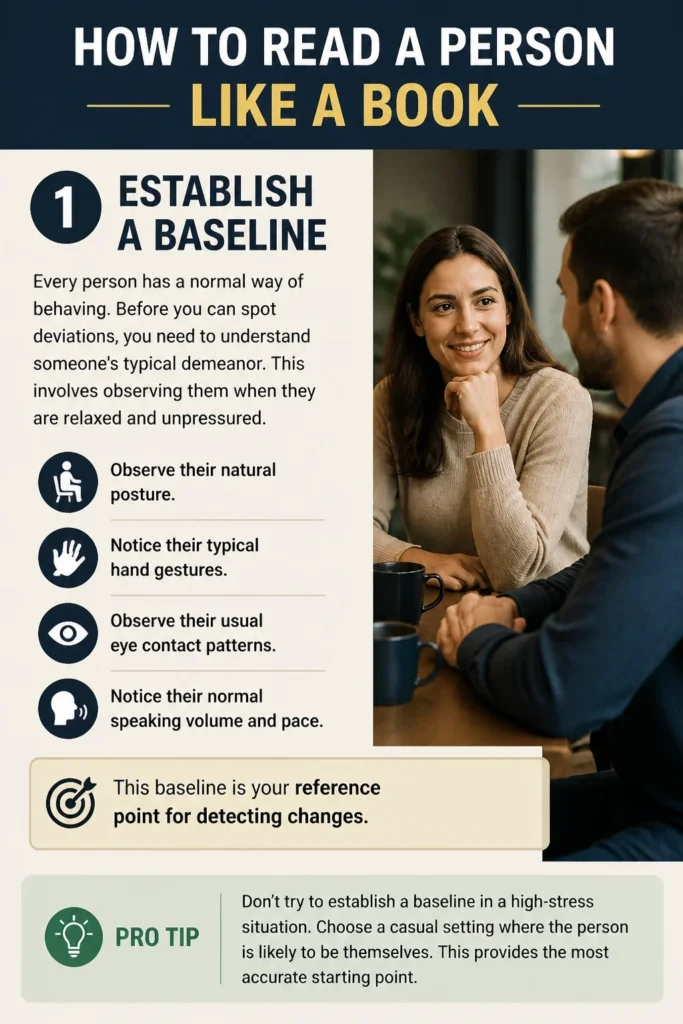
Pro Tip: Don’t try to establish a baseline in a high-stress situation. Choose a casual setting where the person is likely to be themselves. This provides the most accurate starting point.
Step 2: Pay Attention to Body Language
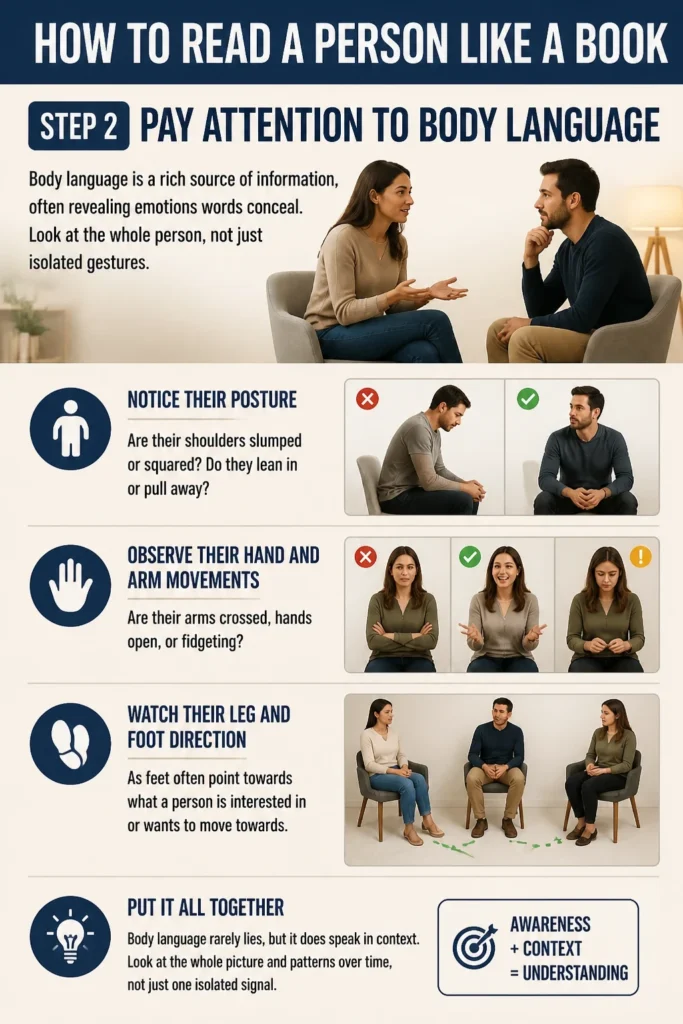
Body language is a rich source of information, often revealing emotions words conceal. Look at the whole person, not just isolated gestures.
Notice their posture: Are their shoulders slumped or squared? Do they lean in or pull away? Observe their hand and arm movements: Are their arms crossed, hands open, or fidgeting? Watch their leg and foot direction, as feet often point towards what a person is interested in or wants to move towards.
Step 3: Decipher Facial Expressions
The face is incredibly expressive, conveying a wide range of emotions in fleeting moments. Learn to recognize the common indicators of joy, sadness, anger, fear, surprise, and disgust.
Look at their eyes: Are they wide, narrowed, or avoiding contact? Observe their mouth: Is it tight, relaxed, or turned up or down at the corners? Pay attention to their eyebrows and forehead, as these areas often show worry, confusion, or anger.
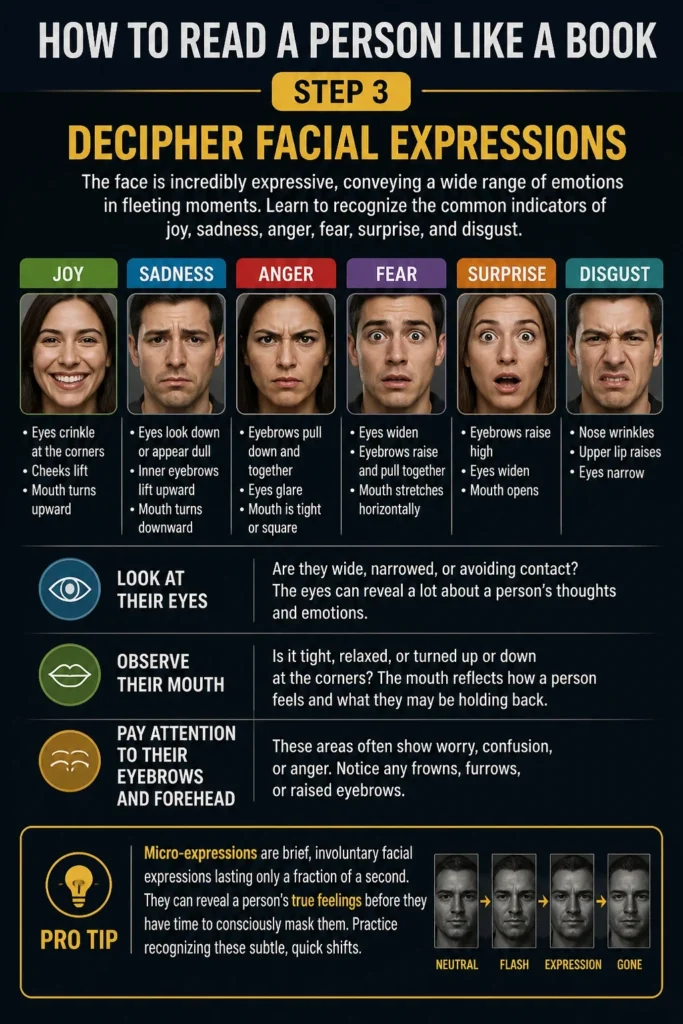
Pro Tip: Micro-expressions are brief, involuntary facial expressions lasting only a fraction of a second. They can reveal a person’s true feelings before they have time to consciously mask them. Practice recognizing these subtle, quick shifts.
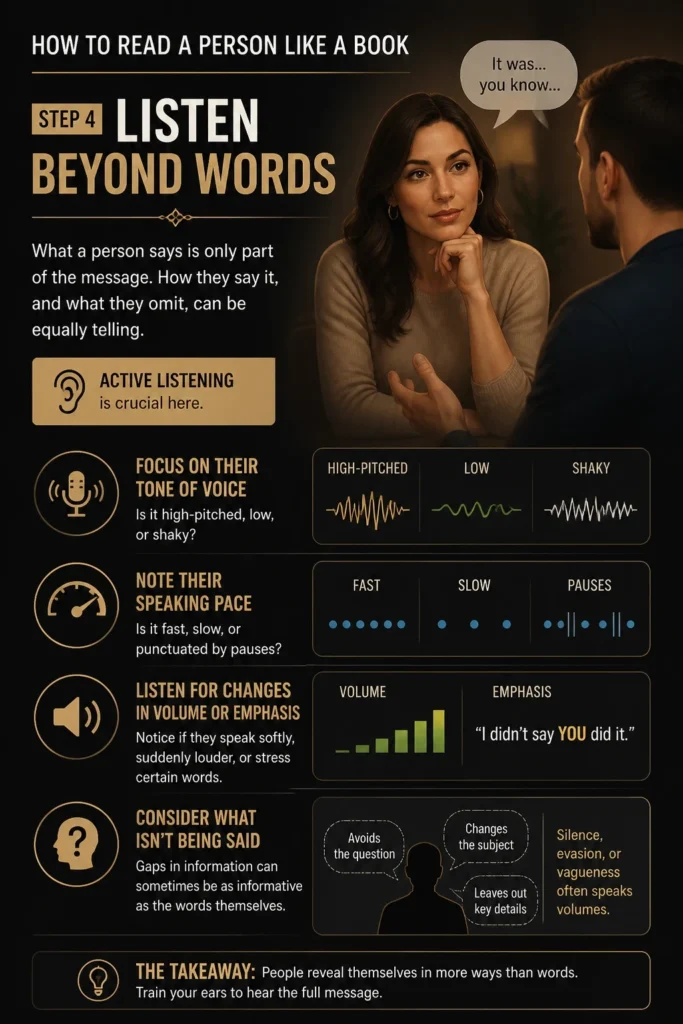
Step 4: Listen Beyond Words
What a person says is only part of the message. How they say it, and what they omit, can be equally telling. Active listening is crucial here.
Focus on their tone of voice: Is it high-pitched, low, or shaky? Note their speaking pace: Is it fast, slow, or punctuated by pauses? Listen for changes in volume or emphasis on certain words. Consider what isn’t being said – gaps in information can sometimes be as informative as the words themselves.
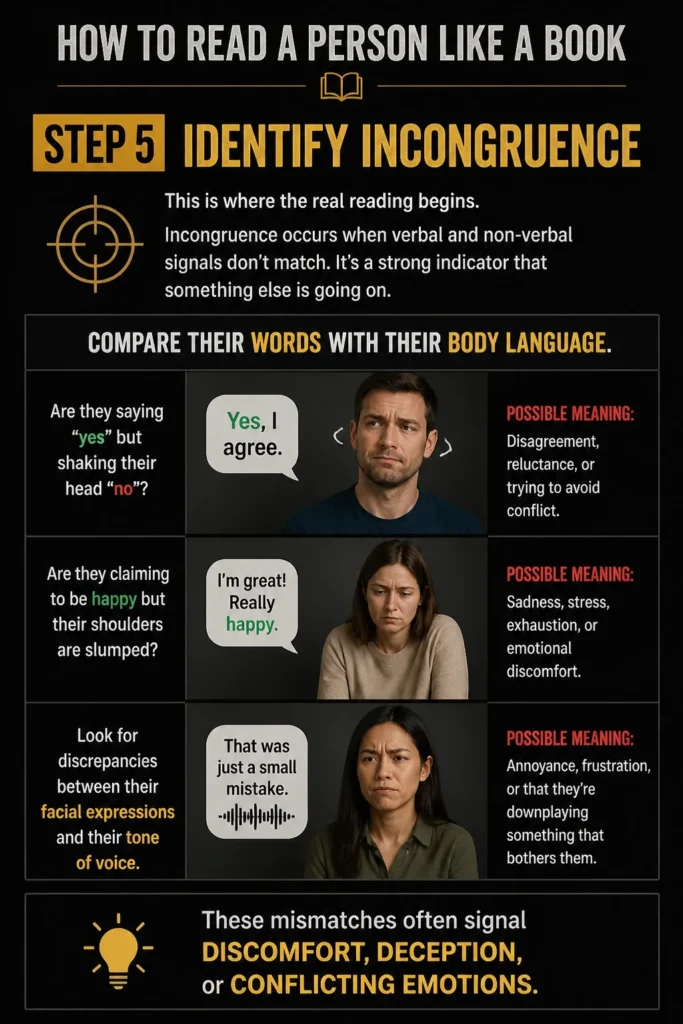
Step 5: Identify Incongruence
This is where the real “reading” begins. Incongruence occurs when verbal and non-verbal signals don’t match. It’s a strong indicator that something else is going on.
Compare their words with their body language. Are they saying “yes” but shaking their head “no”? Are they claiming to be happy but their shoulders are slumped? Look for discrepancies between their facial expressions and their tone of voice. These mismatches often signal discomfort, deception, or conflicting emotions.
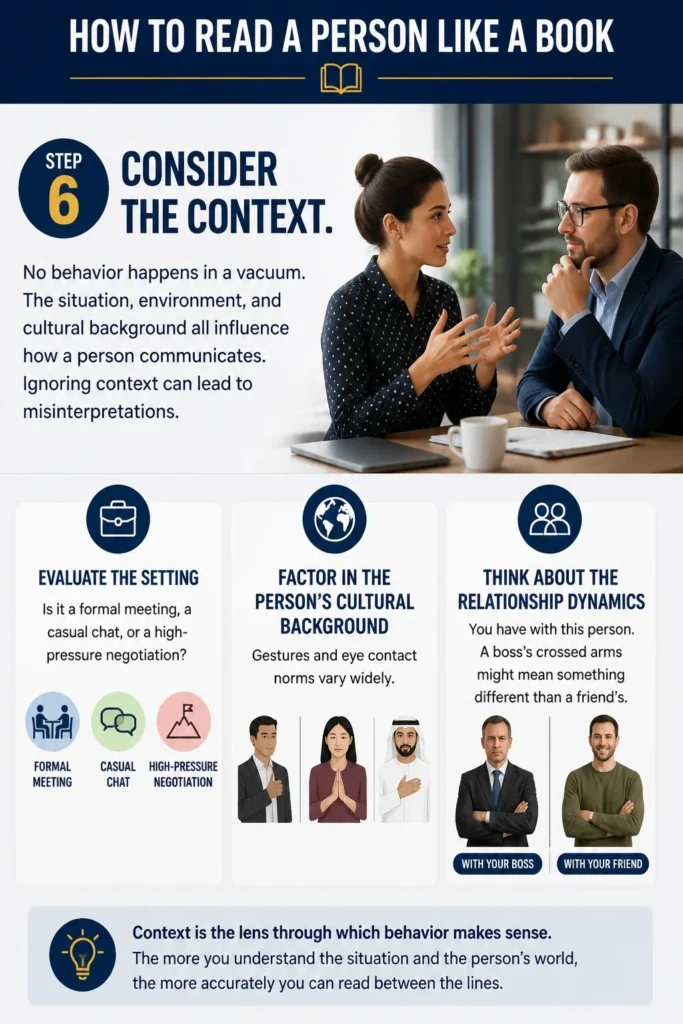
Step 6: Consider the Context
No behavior happens in a vacuum. The situation, environment, and cultural background all influence how a person communicates. Ignoring context can lead to misinterpretations.
Evaluate the setting: Is it a formal meeting, a casual chat, or a high-pressure negotiation? Factor in the person’s cultural background, as gestures and eye contact norms vary widely. Think about the relationship dynamics you have with this person. A boss’s crossed arms might mean something different than a friend’s.
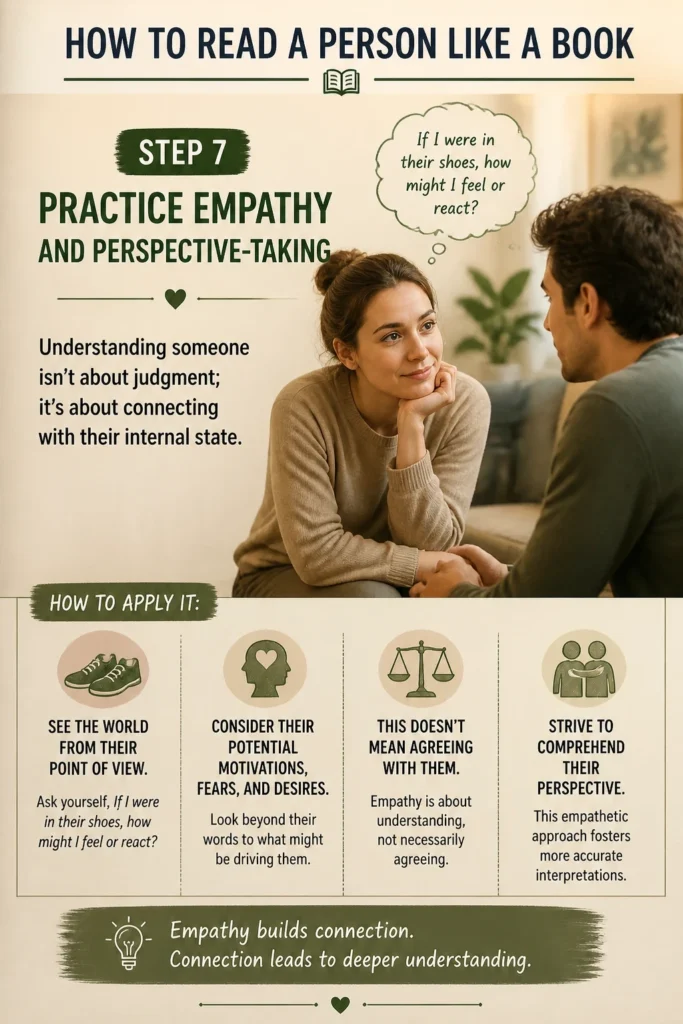
Step 7: Practice Empathy and Perspective-Taking
Understanding someone isn’t about judgment; it’s about connecting with their internal state. Try to see the world from their point of view.
Ask yourself, “If I were in their shoes, how might I feel or react?” Consider their potential motivations, fears, and desires. This doesn’t mean agreeing with them, but rather striving to comprehend their perspective. This empathetic approach fosters more accurate interpretations.
Step 8: Formulate Hypotheses, Don’t Conclude
Treat your observations as data points for a hypothesis, not definitive facts. Human behavior is complex and multi-layered.
Develop a tentative interpretation based on your observations, but remain open to new information. Avoid jumping to immediate, rigid conclusions. Seek opportunities to verify your hypothesis through further observation or gentle, open-ended questions. This iterative process refines your understanding over time.

Common Mistakes to Avoid
Over-Analyzing Isolated Cues
Focusing on just one gesture, like crossed arms, can be misleading. A person might cross their arms because they are cold, not because they are defensive. Always look at clusters of behaviors and the overall picture. Interpreting a single cue in isolation frequently leads to incorrect assumptions and misunderstandings.
Imposing Your Own Interpretations
What a certain behavior means to you might not be what it means to someone else. For example, some cultures view direct eye contact as disrespectful, while others see it as a sign of honesty. Projecting your own biases onto others can severely distort your understanding of their true intentions.
Ignoring Context
Failing to consider the environment, the situation, or cultural differences is a major pitfall. A rapid speech pattern might indicate nervousness in one situation, but simply excitement or passion in another. Without context, even the most obvious cues can be misinterpreted.
Forgetting the Baseline
If you don’t know someone’s normal behavior, you can’t accurately identify deviations. What looks like fidgeting might just be their usual way of expressing energy. Without a baseline, every observation is just a guess, lacking a crucial reference point for comparison.
Troubleshooting
“I feel overwhelmed by all the information.”
It’s natural to feel this way initially. Reading people is a skill that develops over time, not overnight. Start by focusing on just one or two aspects, like eye contact or hand gestures, for a few days. Once you feel more comfortable, gradually add another layer of observation.
Practice in low-stakes environments, like observing people in a coffee shop or on public transport, to build your skills without pressure. Break down the process into manageable chunks, and don’t try to capture everything at once.
“My interpretations feel wrong or inconsistent.”
This is a common experience, especially when starting out. Remember that your observations are hypotheses, not certainties. Revisit the “Consider the Context” step. Are you missing any environmental or cultural factors that might explain the behavior?
Also, check for incongruence. If your interpretation doesn’t align with other cues, it’s likely incorrect. Seek opportunities to gently clarify with the person (if appropriate) to refine your understanding. Continuous learning and self-correction are key.
“People seem guarded or difficult to read.”
Some individuals are naturally more reserved or have learned to mask their emotions effectively. In these cases, focus on very subtle cues and look for patterns over time. A single interaction might not yield much, but repeated observations can reveal consistent behaviors.
Building rapport and trust can also make people more open. When someone feels safe and comfortable, their natural tendencies are more likely to emerge. Be patient and don’t push for information; allow them to reveal themselves at their own pace.
Key Takeaways
- Establishing a personal baseline for each individual is fundamental to recognizing deviations.
- Non-verbal cues like body language, facial expressions, and vocal tone provide rich, often subconscious information.
- Identifying incongruence between verbal and non-verbal signals is a powerful indicator of underlying feelings.
- Always consider the specific context, including culture and environment, to avoid misinterpretations.
- Approach observations with empathy and form hypotheses, rather than jumping to definitive conclusions.
- Reading people is a practiced skill that improves with consistent, mindful effort and self-correction.
Frequently Asked Questions
Is reading people manipulative?
The intent behind reading people determines whether it’s manipulative or helpful. Using these skills to understand and connect better, build stronger relationships, and navigate social situations with empathy is ethical. Using them to exploit, deceive, or control others is manipulative and unethical. The power of observation comes with a responsibility for its ethical application.
Can I read everyone?
While you can develop a much deeper understanding of most people, no one can read everyone perfectly. Some individuals are naturally more expressive, while others are highly skilled at masking their true feelings. Factors like cultural background, personal history, and even mental health can also influence how transparent someone is. The goal is to improve your general perception, not to achieve mind-reading omniscience.
How long does it take to get good at this?
Becoming proficient in reading people is an ongoing journey, not a destination. You can start noticing significant improvements in your observational skills within weeks of consistent practice. However, true mastery, which involves nuanced interpretation and quick assessment, can take months or even years of dedicated effort and real-world application. It’s a skill you continuously refine.
What if I misinterpret someone?
Misinterpretations are a natural part of the learning process. If you realize you’ve misinterpreted someone, the best approach is to remain open-minded and adjust your understanding. If your misinterpretation led to a misunderstanding, a polite and empathetic clarification can often resolve the issue. For example, “I might have misunderstood, could you explain what you meant?” demonstrates humility and a desire to connect accurately.
Our Top Recommended Finds
- A dedicated notebook and pen: For jotting down observations, patterns, and reflections on interactions. This helps solidify learning.
- A comprehensive book on non-verbal communication: To deepen your theoretical understanding of body language and micro-expressions.
- A small, portable mirror: Useful for practicing facial expressions and understanding how different emotions manifest on your own face.
The Ongoing Journey of Understanding
Learning to read people is a profound journey into the complexities of human interaction. It’s not about becoming a detective, but about enhancing your empathy and connection. Each observation refines your understanding, building a richer picture of the world around you.
Start applying these steps today in your daily interactions. Pay attention during your next conversation, observe people in public, and reflect on what you see. The more you practice, the more intuitive this skill becomes. Embrace the challenge, and watch your understanding of others deepen dramatically.