👁️ How To Read People Like A Book
I spent years in high-stakes negotiations where a single missed flinch could cost a fortune.
Learning to decode the silent language of the body changed how I interact with everyone from CEOs to my own family.
This guide shares the exact framework I use to see what people are actually thinking behind their words.

Quick Overview
You will learn to identify hidden emotions, detect discomfort, and build rapport by observing non-verbal cues.
- Time needed: 15-20 minutes to learn, a lifetime to master
- Difficulty: Intermediate
- What you’ll need: A keen eye, active listening skills, and a social environment for practice
Step-by-Step Instructions
Step 1: Establish a Baseline
Observe the person during the first few minutes of your interaction while the conversation is casual.
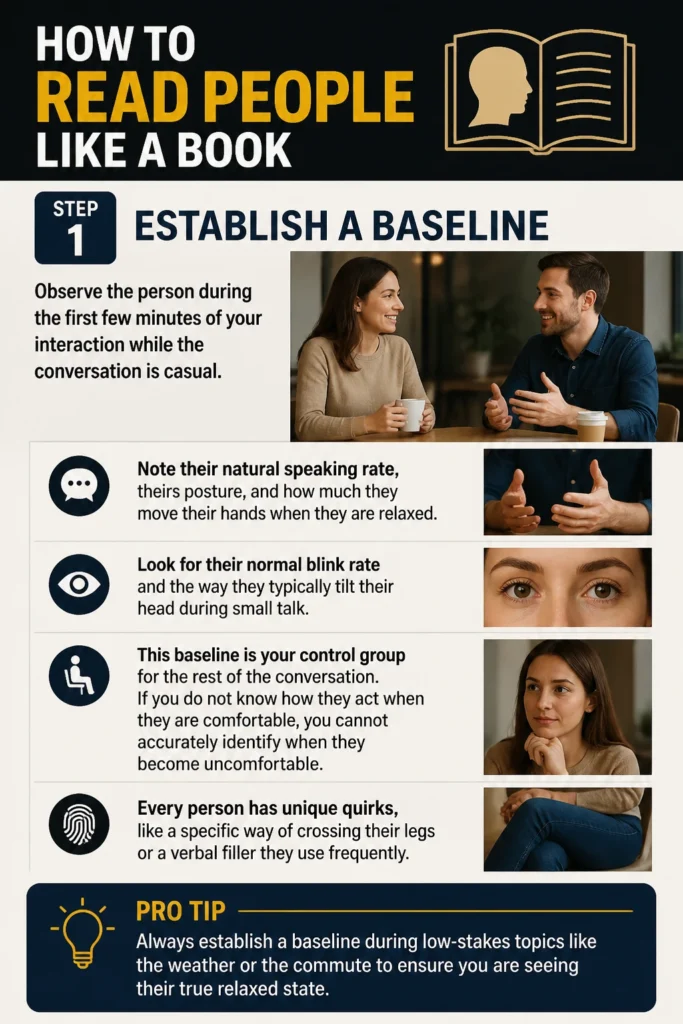
Note their natural speaking rate, their posture, and how much they move their hands when they are relaxed.
Look for their “normal” blink rate and the way they typically tilt their head during small talk.
This baseline is your control group for the rest of the conversation.
If you do not know how they act when they are comfortable, you cannot accurately identify when they become uncomfortable.
Every person has unique quirks, like a specific way of crossing their legs or a verbal filler they use frequently.
Pro Tip: Always establish a baseline during low-stakes topics like the weather or the commute to ensure you are seeing their true relaxed state.
Step 2: Watch the Feet and Legs
Shift your focus downward because the feet are often the most honest part of the human body.
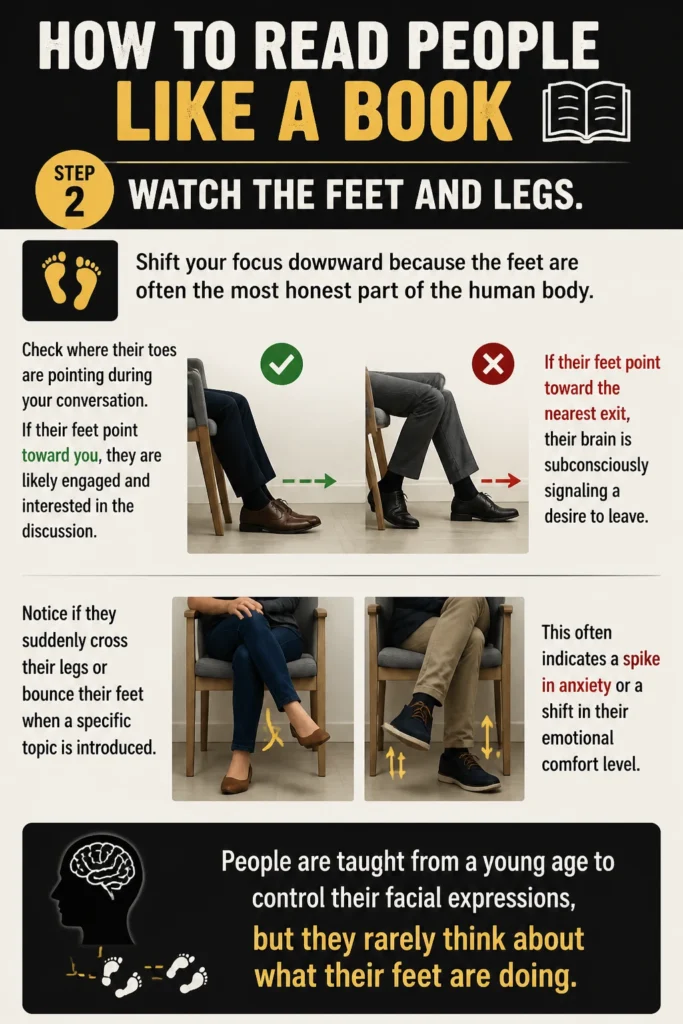
Check where their toes are pointing during your conversation.
If their feet point toward you, they are likely engaged and interested in the discussion.
If their feet point toward the nearest exit, their brain is subconsciously signaling a desire to leave.
Notice if they suddenly cross their legs or bounce their feet when a specific topic is introduced.
This often indicates a spike in anxiety or a shift in their emotional comfort level.
People are taught from a young age to control their facial expressions, but they rarely think about what their feet are doing.
Step 3: Analyze Ventral Shielding
Identify whether the person is exposing or protecting the front of their body.
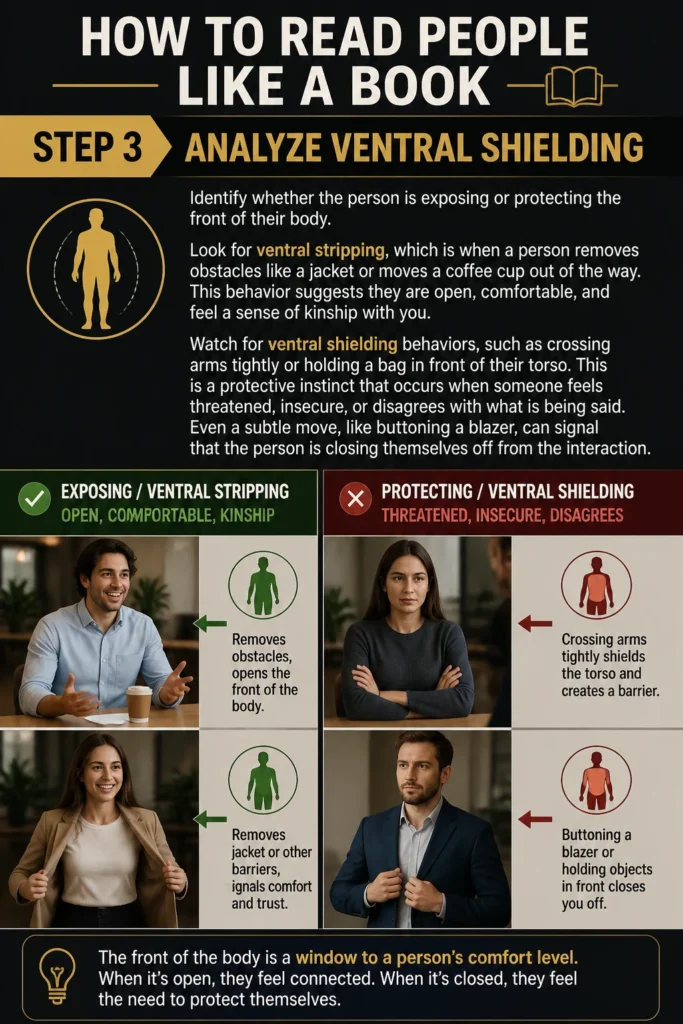
Look for “ventral stripping,” which is when a person removes obstacles like a jacket or moves a coffee cup out of the way.
This behavior suggests they are open, comfortable, and feel a sense of kinship with you.
Watch for “ventral shielding” behaviors, such as crossing arms tightly or holding a bag in front of their torso.
This is a protective instinct that occurs when someone feels threatened, insecure, or disagrees with what is being said.
Even a subtle move, like buttoning a blazer, can signal that the person is closing themselves off from the interaction.
Step 4: Decode Hand and Arm Gestures
Focus on the hands to understand a person’s confidence levels.
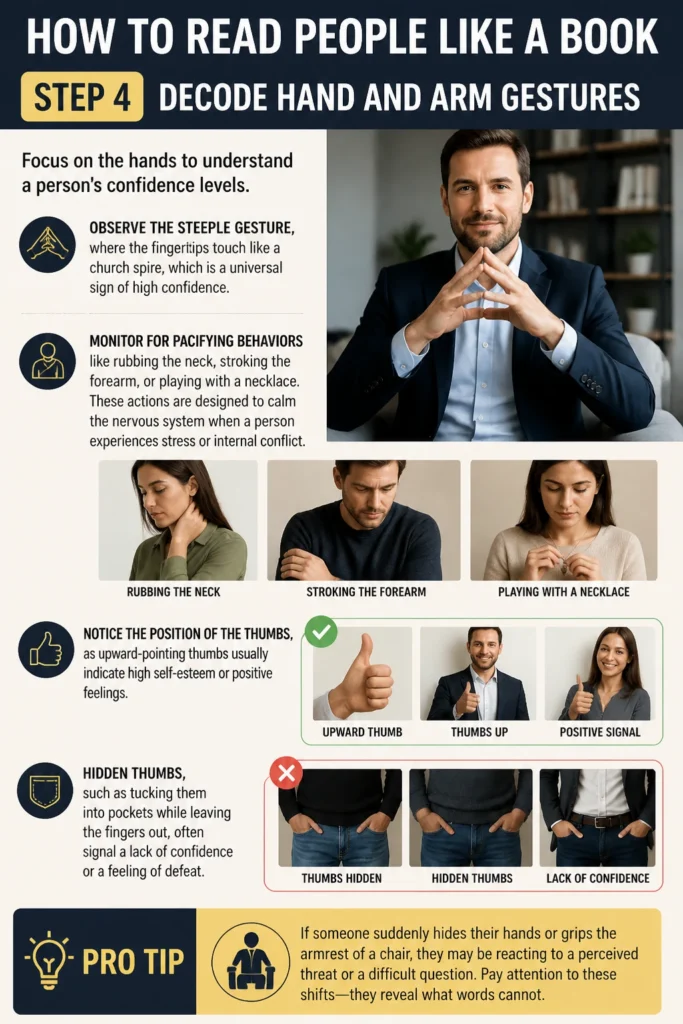
Observe the “steeple” gesture, where the fingertips touch like a church spire, which is a universal sign of high confidence.
Monitor for “pacifying behaviors” like rubbing the neck, stroking the forearm, or playing with a necklace.
These actions are designed to calm the nervous system when a person experiences stress or internal conflict.
Notice the position of the thumbs, as upward-pointing thumbs usually indicate high self-esteem or positive feelings.
Hidden thumbs, such as tucking them into pockets while leaving the fingers out, often signal a lack of confidence or a feeling of defeat.
Pro Tip: If someone suddenly hides their hands or grips the armrest of a chair, they may be reacting to a perceived threat or a difficult question.
Step 5: Interpret Facial Micro-expressions
Scan the face for fleeting expressions that last only a fraction of a second.
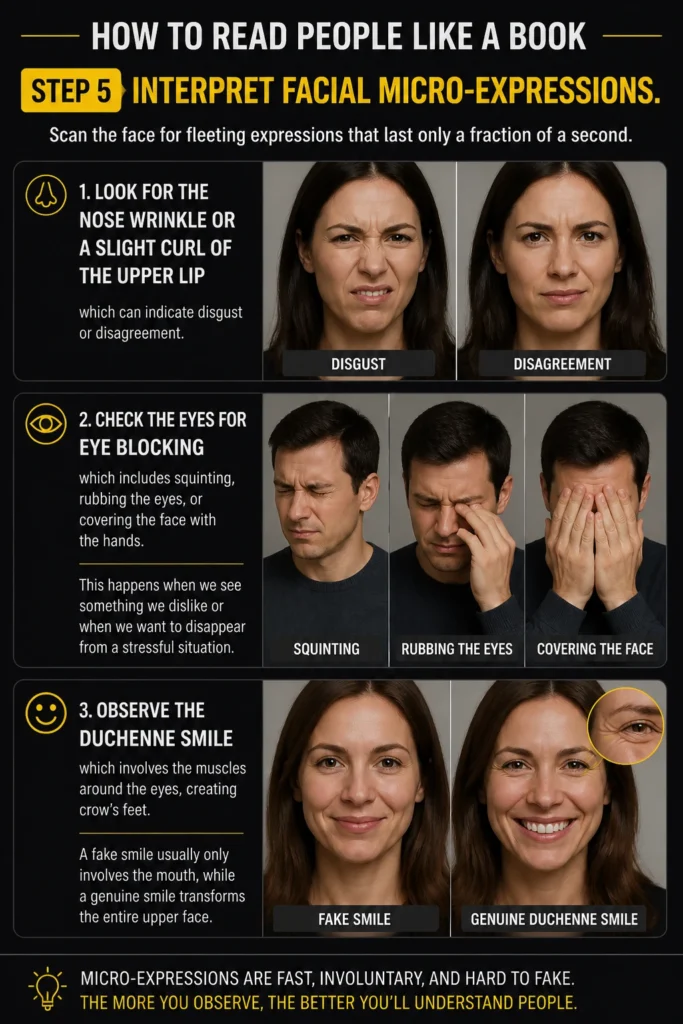
Look for the “nose wrinkle” or a slight curl of the upper lip, which can indicate disgust or disagreement.
Check the eyes for “eye blocking,” which includes squinting, rubbing the eyes, or covering the face with the hands.
This happens when we see something we dislike or when we want to “disappear” from a stressful situation.
Observe the “Duchenne smile,” which involves the muscles around the eyes, creating “crow’s feet.”
A fake smile usually only involves the mouth, while a genuine smile transforms the entire upper face.
Step 6: Listen to Vocal Tonality and Speed
Pay attention to changes in the pitch and rhythm of their voice relative to their baseline.
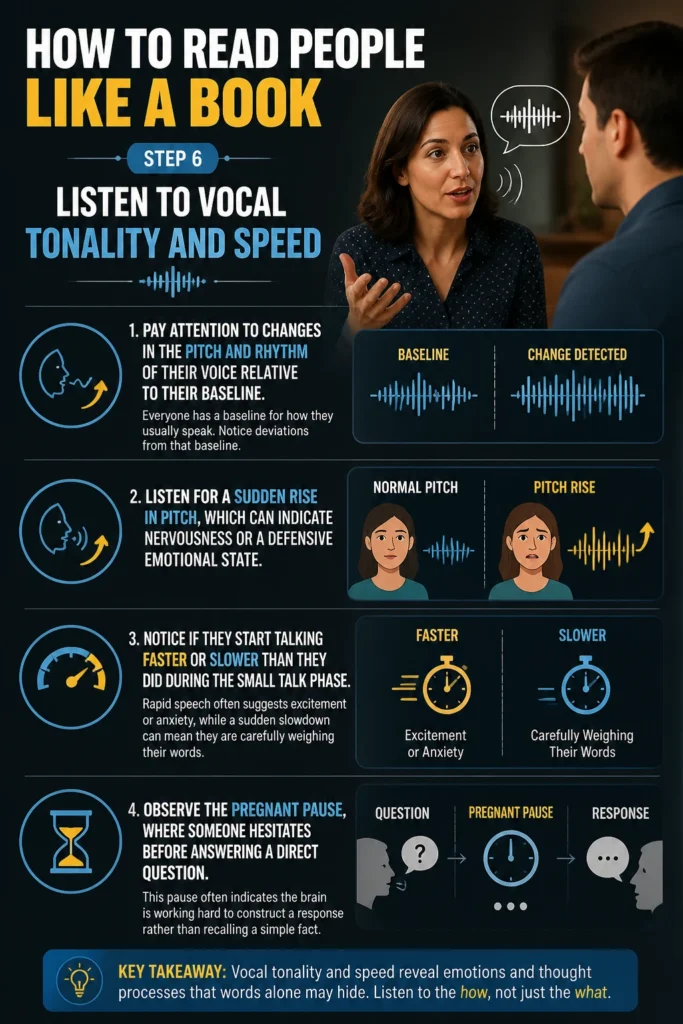
Listen for a sudden rise in pitch, which can indicate nervousness or a defensive emotional state.
Notice if they start talking faster or slower than they did during the small talk phase.
Rapid speech often suggests excitement or anxiety, while a sudden slowdown can mean they are carefully weighing their words.
Observe the “pregnant pause,” where someone hesitates before answering a direct question.
This pause often indicates the brain is working hard to construct a response rather than recalling a simple fact.
Step 7: Identify Clusters of Behavior
Avoid making a judgment based on a single gesture or movement.
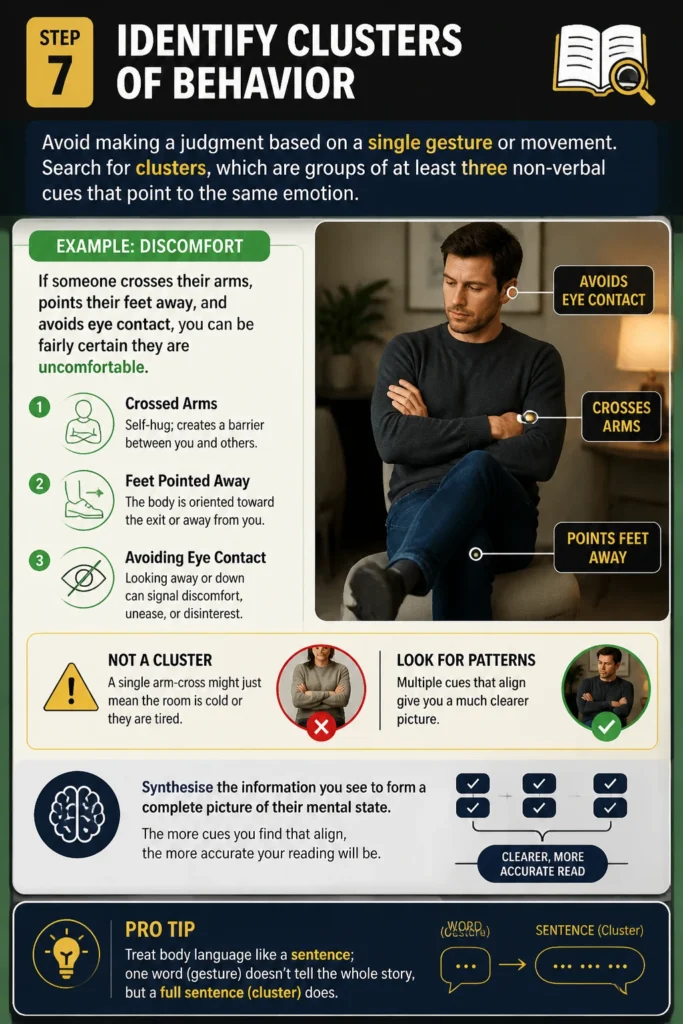
Search for “clusters,” which are groups of at least three non-verbal cues that point to the same emotion.
For example, if someone crosses their arms, points their feet away, and avoids eye contact, you can be fairly certain they are uncomfortable.
A single arm-cross might just mean the room is cold or they are tired.
Synthesize the information you see to form a complete picture of their mental state.
The more cues you find that align, the more accurate your reading will be.
Pro Tip: Treat body language like a sentence; one word (gesture) doesn’t tell the whole story, but a full sentence (cluster) does.
Step 8: Evaluate the Context
Consider the environment and the situation before finalizing your interpretation.
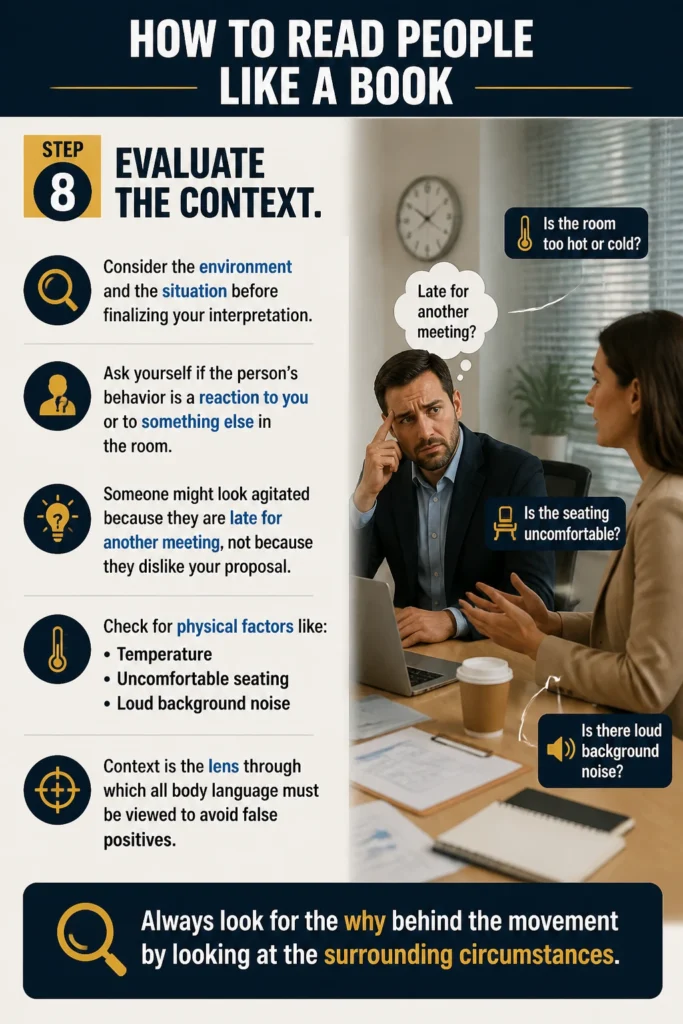
Ask yourself if the person’s behavior is a reaction to you or to something else in the room.
Someone might look agitated because they are late for another meeting, not because they dislike your proposal.
Check for physical factors like temperature, uncomfortable seating, or loud background noise.
Context is the lens through which all body language must be viewed to avoid false positives.
Always look for the “why” behind the movement by looking at the surrounding circumstances.
Common Mistakes to Avoid
Over-interpreting Single Cues
Many beginners see one person touch their nose and immediately assume they are lying.
This is a mistake because that person might simply have an itchy nose or allergies.
Relying on a single gesture leads to inaccurate readings and damaged relationships.
Always look for multiple signs that support your theory before drawing a conclusion.
Ignoring Cultural Differences
Body language is not entirely universal across all cultures and backgrounds.
In some cultures, direct eye contact is a sign of respect, while in others, it is considered aggressive or rude.
Failing to account for a person’s cultural upbringing will lead to significant misunderstandings.
Research the norms of the person you are interacting with to ensure your “reading” is culturally informed.
Projecting Your Own Emotions
It is easy to see what you expect to see rather than what is actually happening.
If you are feeling nervous, you might interpret someone’s neutral expression as boredom or judgment.
This is known as confirmation bias and it clouds your objective observation skills.
Try to remain an impartial observer and focus strictly on the physical data presented by the other person.
Troubleshooting
The Person is Hard to Read
Some people, like experienced poker players or high-level executives, have learned to mask their emotions.
When you encounter a “stone face,” focus on their lower body or their hands, which are harder to control.
You can also try changing the environment or the topic suddenly to see if it breaks their composure.
Look for very subtle “micro-shifts” in their posture or the tension in their jawline.
You Get Distracted by Your Own Thoughts
Reading people requires intense focus and presence, which can be difficult if you are worried about what to say next.
Practice active listening by summarizing what the other person said before you respond.
This gives your brain a moment to process their non-verbal cues while keeping you engaged in the conversation.
Start by practicing in low-stakes environments, like a coffee shop or a park, where you don’t have to participate.
Key Takeaways
- Always start by establishing a baseline of “normal” behavior for the individual.
- Prioritize the lower body, especially the feet, as they are less likely to be consciously controlled.
- Look for clusters of at least three cues to confirm an emotional state or reaction.
- Remember that context and culture are vital for accurate interpretation of non-verbal signals.
- Watch for pacifying behaviors like neck touching to identify when someone is feeling stressed.
- Maintain objectivity to avoid projecting your own biases onto the other person’s actions.
Frequently Asked Questions
Can you really tell if someone is lying just by looking at them?
No single body language cue is a definitive “lie detector.” However, you can spot “cognitive load” and stress, which often accompany deception. When someone lies, their brain has to work harder, leading to pauses, shifts in baseline, and increased pacifying behaviors.
Is eye contact the most important thing to watch?
Actually, eye contact is one of the easiest things for people to manipulate. Liars often make more eye contact than usual to see if you believe them. While eyes provide clues like pupil dilation, the feet and hands are often more reliable indicators of true feelings.
How long does it take to get good at reading people?
You can learn the basic principles in a day, but becoming proficient takes consistent practice. Start by observing people in public places for 10 minutes a day. Within a few months, you will notice patterns and shifts automatically without having to think about them.
Does crossing arms always mean someone is angry?
Not at all. Someone might cross their arms because they are cold, because the chair has no armrests, or because it is a comfortable habit. You must look for other signs, like a tensed jaw or narrowed eyes, to determine if the arm-crossing is actually defensive.
Our Top Recommended Finds
- A high-quality notebook: Keeping a journal of your observations helps you track patterns and refine your skills over time.
- A polarized pair of sunglasses: These allow you to observe others in public settings without them noticing you are studying their behavior.
- A digital voice recorder: Recording your own conversations (with permission) lets you review vocal tonality and pauses later for self-improvement.
Sharpen Your Social Intuition Today
Reading people is not about manipulation; it is about building deeper empathy and understanding.
When you can see the silent signals others are sending, you can respond to their needs more effectively.
Start your practice today by observing one person’s baseline during your next conversation.
You might also want to explore the science of “proxemics” to understand how people use physical space to signal their feelings.
The more you watch, the more the world will open up to you like a book waiting to be read.