✍️ How To Write Application Letter For Job
Applying for jobs can feel like sending messages into a void. Many job seekers struggle to get noticed.
I remember the frustration of crafting generic letters, only to hear nothing back. It felt like my efforts were wasted.
This guide shares the exact strategies I’ve learned and refined to make your application stand out and grab attention.

Quick Overview
This guide will walk you through creating a compelling application letter. You will learn how to tailor your message and present your best self to potential employers. By the end, you’ll have a clear process for writing letters that get results.
- Time needed: 2-3 hours (initial read-through and first draft)
- Difficulty: Intermediate
- What you’ll need: Job description, your resume, company research, a word processor
Step-by-Step Instructions
Step 1: Understand the Job and Company
Before writing, thoroughly read the job description. Identify key responsibilities, required skills, and desired qualifications. This document is your blueprint.
Research the company culture, recent projects, and their mission. Look for information on their “About Us” page, news releases, and social media. Understanding their values helps you align your letter.
Your goal is to understand what problem the company is trying to solve with this hire. Then, you can position yourself as the solution.
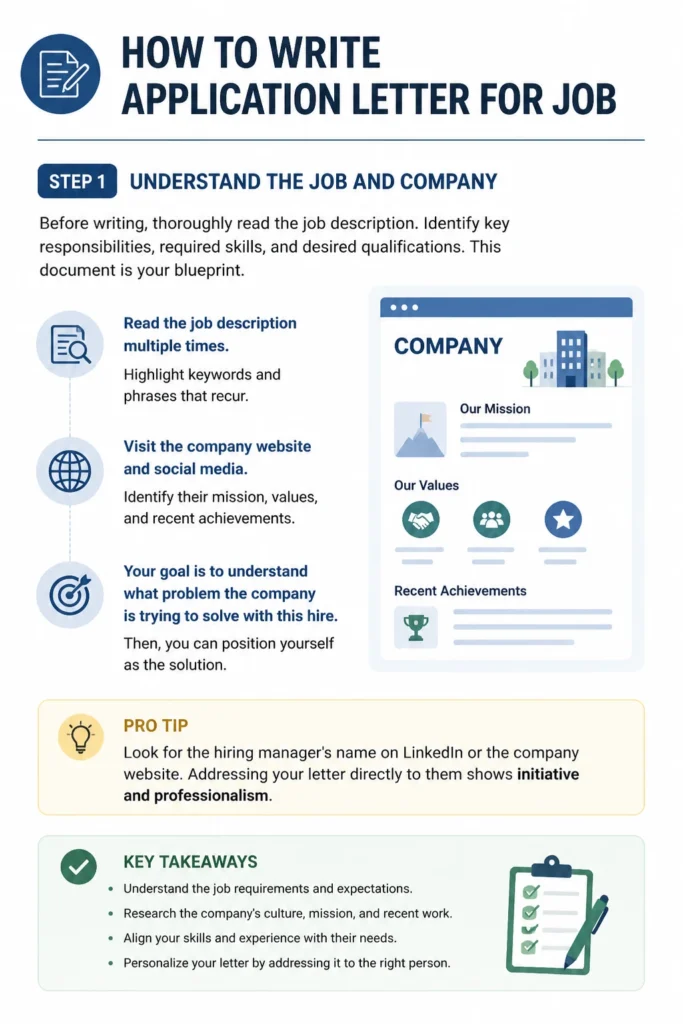
- Read the job description multiple times.
- Highlight keywords and phrases that recur.
- Visit the company website and social media.
- Identify their mission, values, and recent achievements.
Pro Tip: Look for the hiring manager’s name on LinkedIn or the company website. Addressing your letter directly to a person is always better than “To Whom It May Concern.”
Step 2: Choose the Right Format and Structure
A standard business letter format is professional and easy to read. Clarity in presentation reflects your attention to detail.
Your letter should typically be one page long, concise and to the point. Recruiters often scan letters quickly.
The structure usually includes your contact information, the date, the employer’s contact information, a salutation, body paragraphs, a closing, and your signature.
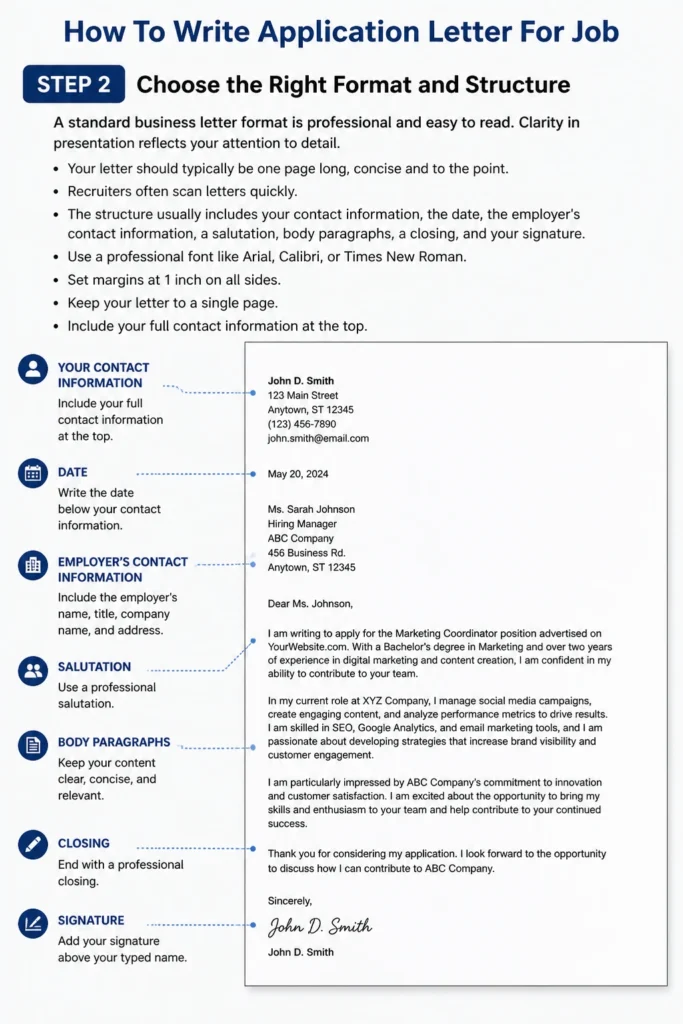
- Use a professional font like Arial, Calibri, or Times New Roman.
- Set margins at 1 inch on all sides.
- Keep your letter to a single page.
- Include your full contact information at the top.
Step 3: Craft a Compelling Opening Paragraph
Your first paragraph must immediately capture the reader’s attention. State the position you are applying for and where you saw the advertisement.
Express genuine enthusiasm for the role and the company. Show that you have done your homework.
Briefly mention one or two key qualifications that make you an ideal candidate. This immediately hooks the reader.

- Clearly state the job title you are applying for.
- Mention where you learned about the opportunity.
- Express your enthusiasm for the role and the company.
- Hint at your most relevant qualification.
Step 4: Develop Strong Body Paragraphs
These paragraphs are where you connect your skills and experiences directly to the job requirements. Do not just repeat your resume. Instead, elaborate on specific achievements.
Use the keywords you identified in Step 1. Show how your past successes align with the company’s needs.
Focus on quantifiable results whenever possible. Numbers demonstrate impact and value.
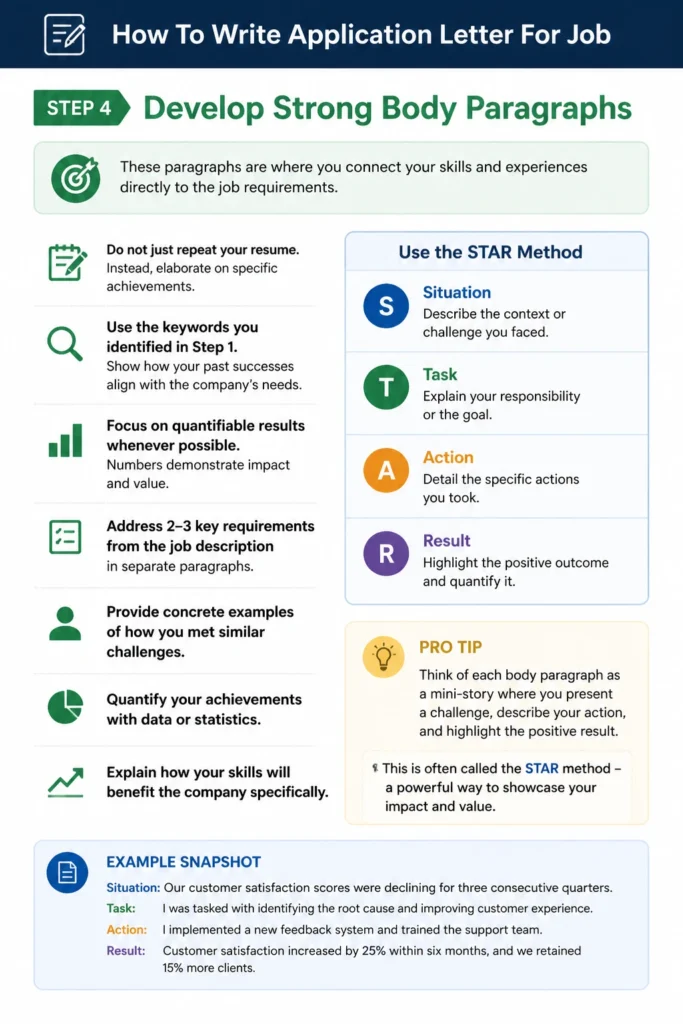
- Address 2-3 key requirements from the job description in separate paragraphs.
- Provide concrete examples of how you met similar challenges.
- Quantify your achievements with data or statistics.
- Explain how your skills will benefit the company specifically.
Pro Tip: Think of each body paragraph as a mini-story where you present a challenge, describe your action, and highlight the positive result. This is often called the STAR method (Situation, Task, Action, Result).
Step 5: Write a Powerful Closing Paragraph
Reiterate your strong interest in the position and the company. Briefly summarize your main selling points without repeating yourself.
Express your eagerness for an interview. This shows confidence and proactive engagement.
Thank the hiring manager for their time and consideration. Always maintain a professional and courteous tone.
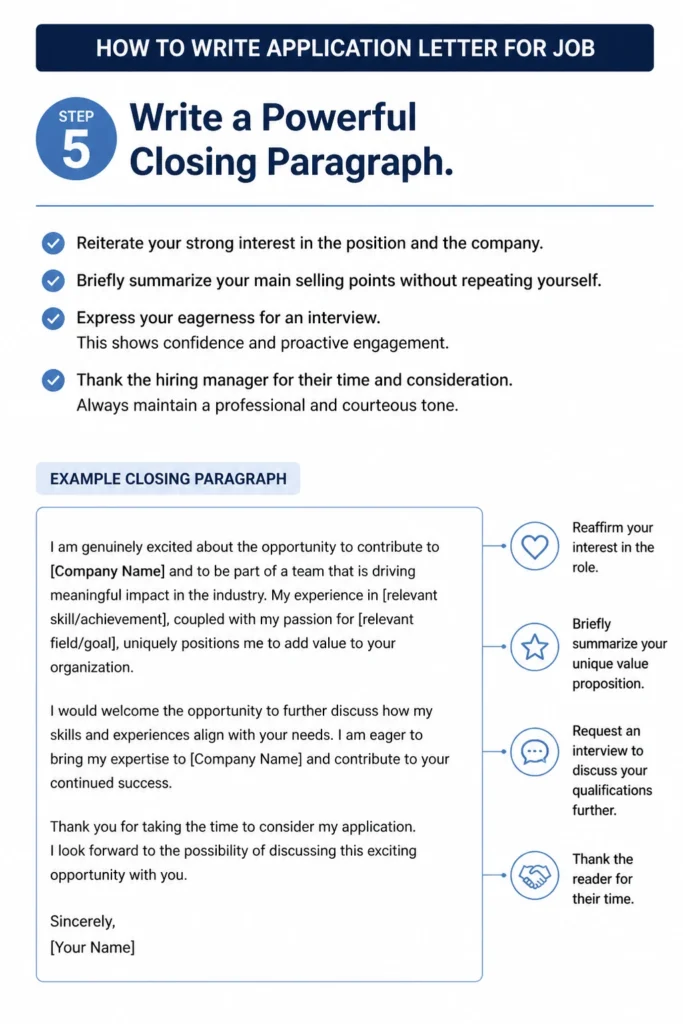
- Reaffirm your interest in the role.
- Briefly summarize your unique value proposition.
- Request an interview to discuss your qualifications further.
- Thank the reader for their time.
Step 6: Proofread and Edit Meticulously
Typos and grammatical errors can severely undermine your professionalism. A flawless letter shows attention to detail.
Read your letter aloud to catch awkward phrasing or errors your eyes might miss. Ask someone else to review it.
Check for consistency in formatting and tone. Ensure all names and titles are spelled correctly.
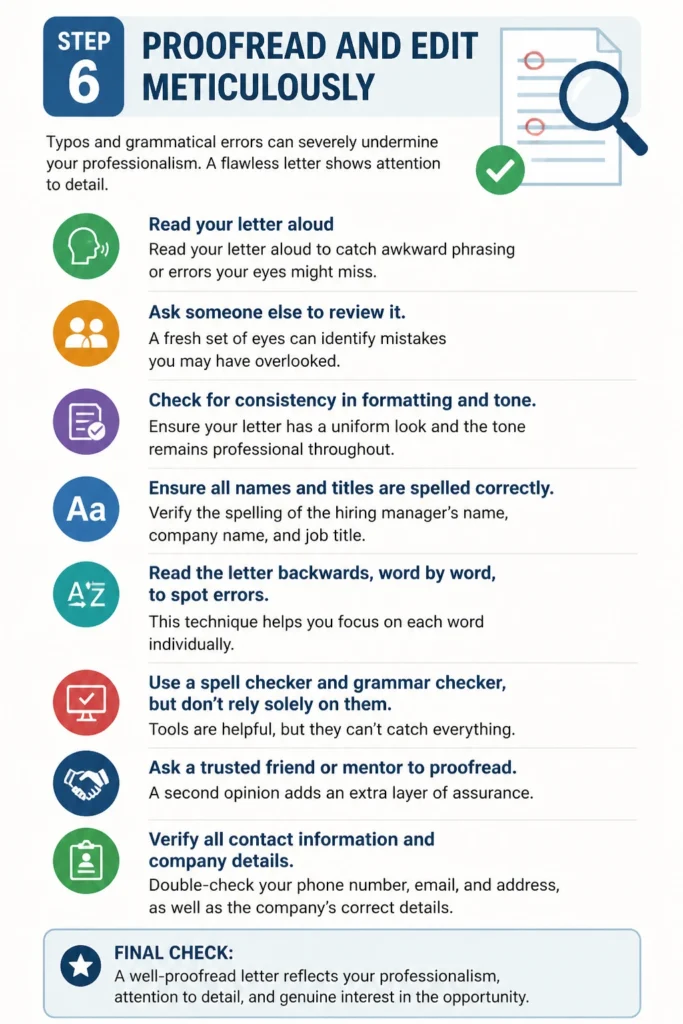
- Read the letter backwards, word by word, to spot errors.
- Use a spell checker and grammar checker, but don’t rely solely on them.
- Ask a trusted friend or mentor to proofread.
- Verify all contact information and company details.
Step 7: Save and Send Your Application
Save your application letter as a PDF file. This preserves your formatting and ensures it looks the same on any computer.
Name the file professionally, typically using your name and the job title (e.g., “JaneDoe_MarketingManager_CoverLetter.pdf”). Follow any specific submission instructions provided by the employer.
When attaching your letter to an email, write a brief, professional email body. Reference the attached documents and the position you are applying for.
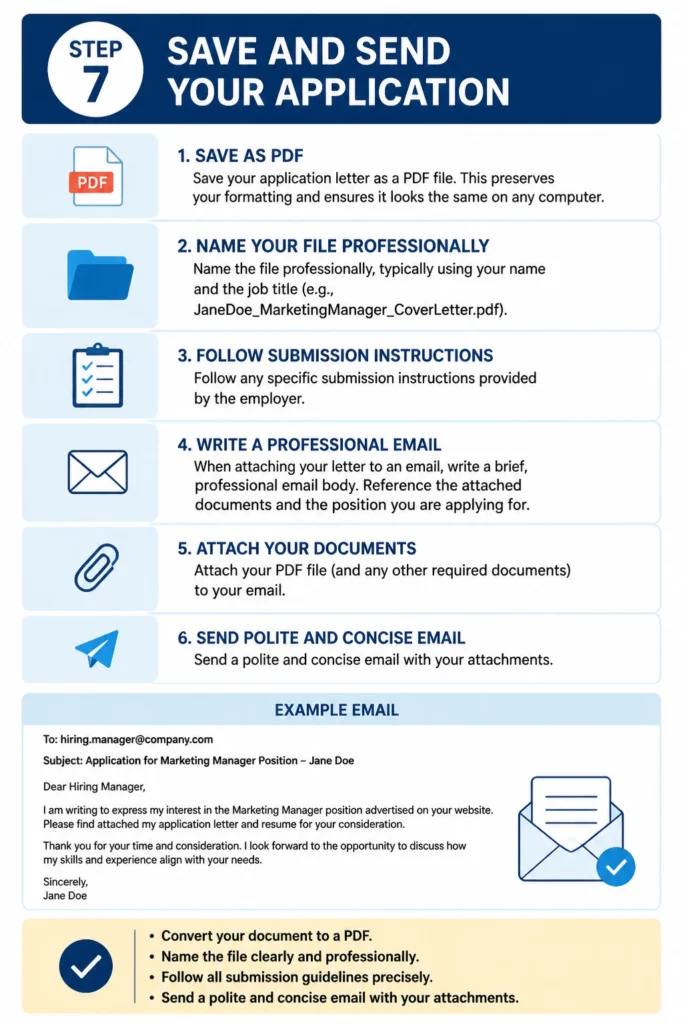
- Convert your document to a PDF.
- Name the file clearly and professionally.
- Follow all submission guidelines precisely.
- Send a polite and concise email with your attachments.
Common Mistakes to Avoid
Generic Letters
Sending the same letter to every job opening is a common pitfall. Employers can easily spot a templated message that lacks specific details about their company or the role. This shows a lack of effort and genuine interest. Always tailor your letter to each unique application, highlighting how your skills directly match their specific needs.
Repeating Your Resume Verbatim
Your application letter should complement your resume, not duplicate it. Avoid simply listing bullet points from your resume. Instead, use the letter to tell a story, provide context, and expand on key achievements. Explain the “why” and “how” behind your experiences, demonstrating your thought process and impact.
Poor Proofreading
Nothing detracts from a professional image faster than typos, grammatical errors, or incorrect names. These mistakes suggest carelessness and a lack of attention to detail, which are undesirable traits in any employee. Always proofread your letter meticulously, and ideally, have another person review it before sending.
Focusing Only on Yourself
While the letter is about you, its underlying purpose is to show what you can do for the employer. A common mistake is to only talk about what you want or what you achieved without connecting it to the company’s needs. Shift your focus to how your skills and experience will benefit their team and help them achieve their goals.
Troubleshooting
Not Hearing Back After Applying
If you are not receiving interview requests, your letter might not be effectively conveying your value. Revisit your opening paragraph and body paragraphs. Ensure you are clearly articulating how your skills solve the company’s specific problems, rather than just listing qualifications. Ask for feedback from a trusted peer or career counselor.
Struggling to Customize Each Letter
Customizing every letter can feel time-consuming, but it is essential. If you find yourself struggling, dedicate more time to Step 1: “Understand the Job and Company.” The deeper your understanding, the easier it becomes to connect your experience to their specific needs. Create a master list of your accomplishments to draw from, making tailoring easier.
Feeling Overwhelmed by the Process
Writing an effective application letter can seem daunting at first. Break the process down into smaller, manageable tasks. Focus on one section at a time, like researching the company, then drafting the opening, then a body paragraph. Taking small steps prevents burnout and makes the entire process more achievable.
Key Takeaways
- Always research the company and job thoroughly before writing.
- Tailor your letter to each specific role and employer.
- Focus on quantifiable achievements and how they benefit the company.
- Maintain a professional, concise, and error-free presentation.
- Express genuine enthusiasm and a clear call to action for an interview.
- Proofread meticulously and consider getting a second opinion.
Frequently Asked Questions
How long should an application letter be?
An application letter should ideally be one page long. Recruiters and hiring managers have limited time, so a concise and impactful letter is most effective. Focus on quality over quantity, ensuring every sentence adds value.
Should I use a formal or informal tone?
Always use a formal and professional tone for an application letter. This reflects respect for the company and the application process. Even if the company culture seems casual, maintain professionalism in your written correspondence.
Is an application letter still necessary in the age of online applications?
Yes, in most cases, an application letter is still highly recommended, even if optional. It provides an opportunity to elaborate on your resume, demonstrate your communication skills, and show your genuine interest in the specific role and company. It helps you stand out from other applicants.
What if the job description doesn’t list a hiring manager’s name?
If you cannot find a specific name after diligent research, you can use a general but professional salutation. Phrases like “Hiring Manager,” “Hiring Team,” or “Dear [Department Name] Team” are appropriate alternatives. Avoid “To Whom It May Concern” as it is outdated and impersonal.
Our Top Recommended Finds
- High-Quality Notebook and Pen: Perfect for brainstorming ideas and outlining your letter before typing.
- Ergonomic Keyboard and Mouse: Reduces strain during extended writing sessions, making the process more comfortable.
- Reliable Printer: Essential for printing a physical copy of your letter for a final, meticulous proofread away from the screen.
Your Path to a Standout Application
You now have a clear roadmap for crafting an application letter that truly shines. This guide provides the tools to move beyond generic submissions.
Take these steps and apply them to your next job application. The effort you put into customizing your letter will undoubtedly set you apart.
Start today, and transform your job search into a series of meaningful connections. Your next career opportunity awaits your compelling story.