📝 How To Write An Essay High Schools
Staring at a blank screen while the cursor blinks can feel like a countdown to a deadline you aren’t ready for.
I remember staying up until 2:00 AM in tenth grade because I didn’t know how to turn my random thoughts into a structured argument.
This guide comes from years of tutoring students and grading papers to show you that writing isn’t about magic; it’s about a repeatable process.

Quick Overview
You will learn to transform a vague prompt into a polished, high-scoring paper by following a clear, logical sequence.
- Time needed: 3-6 hours (spread over a few days)
- Difficulty: Intermediate
- What you’ll need: A clear prompt, a laptop or notebook, and a quiet space.
Step-by-Step Instructions
Step 1: Decode the Prompt
Read the assignment description at least three times to ensure you understand exactly what the teacher wants.
Circle the action verbs in the prompt, such as “compare,” “analyze,” “evaluate,” or “describe.”
Identify the specific constraints, including the required word count, citation style, and the number of sources you need to use.
Pro Tip: If the prompt asks you to “analyze,” don’t just summarize the story; explain how the author uses specific tools to create meaning.
Step 2: Gather Evidence and Brainstorm
List every idea that comes to mind when you think about the topic without worrying about whether the ideas are “good” yet.
Search for quotes, statistics, or historical facts that support these initial ideas in your textbook or through online databases.
Organize your notes by grouping similar pieces of evidence together into categories that could eventually become your main points.
Highlight the strongest pieces of evidence that directly answer the prompt’s main question.
Step 3: Craft a Thesis Statement
Write one sentence that clearly states your main argument and outlines the reasons you will use to support it.
Avoid making a statement of fact, such as “The Great Gatsby was written by F. Scott Fitzgerald.”
Ensure your thesis is debatable, meaning someone could reasonably disagree with your point of view.
Check that your thesis acts as a roadmap, telling the reader exactly what to expect in the paragraphs that follow.
Pro Tip: A strong thesis often uses a “Because” or “Although” structure to show the relationship between your ideas.
Step 4: Build a Skeleton Outline
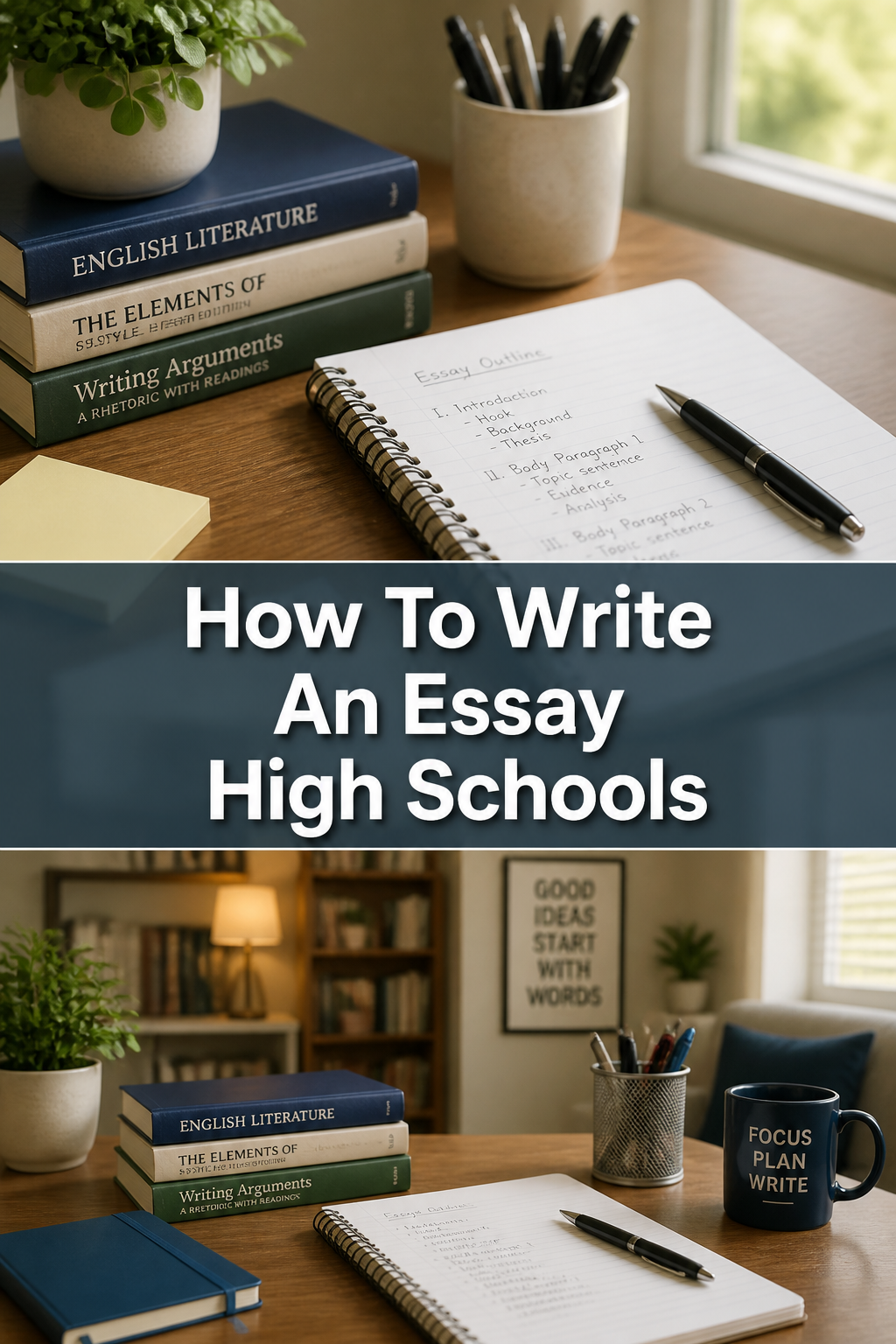
Create a bulleted list for your introduction, three body paragraphs, and a conclusion.
Assign one specific sub-topic or reason from your thesis to each of the three body paragraphs.
Plug your gathered evidence into the outline under the relevant body paragraph headings.
Draft a quick topic sentence for each paragraph that explains what that section will prove.
Step 5: Write the Body Paragraphs
Start each paragraph with a topic sentence that connects back to your thesis statement.
Introduce your evidence by providing context so the reader knows where the information is coming from.
Insert your quote or fact and immediately follow it with two or three sentences of your own analysis.
Explain why the evidence proves your point rather than just letting the quote speak for itself.
Finish the paragraph with a transition sentence that leads the reader into the next idea.
Step 6: Hook Your Reader in the Introduction
Open with a “hook” that grabs attention, such as a surprising statistic, a provocative question, or a relevant quote.
Provide brief background information on the topic to give the reader the context they need to understand your argument.
Place your thesis statement at the very end of the introduction paragraph.
Keep the introduction concise and focused, avoiding long-winded history lessons that aren’t relevant to your specific point.
Step 7: Wrap It Up in the Conclusion
Restate your thesis in a new way, using different words to reinforce your main argument without being repetitive.
Summarize the main points you made in your body paragraphs to remind the reader of your evidence.
End with a “final thought” that connects your topic to a larger issue or leaves the reader with something to think about.
Avoid introducing brand new information or evidence in the conclusion that wasn’t mentioned earlier.
Step 8: The Polish Phase
Read your essay out loud to catch awkward phrasing, run-on sentences, or missing words.
Check your citations to make sure they follow the specific format (MLA, APA, or Chicago) requested by your teacher.
Verify that your tone remains academic and professional throughout the entire paper.
Ask a friend or family member to read the draft to see if your argument makes sense to an outside perspective.
Pro Tip: Take a 24-hour break between finishing your draft and starting your final edit to see the work with fresh eyes.
Common Mistakes to Avoid
The “Since the Beginning of Time” Opening
Many students start their essays with broad, sweeping generalizations like “Throughout history, humans have always loved stories.”
These openings are too vague and don’t add value to your specific argument.
Instead, start with a specific observation or a direct connection to the text or topic you are discussing.
Summarizing Instead of Analyzing
It is easy to fall into the trap of simply retelling the plot of a book or the events of a historical period.
Your teacher already knows the story; they want to see your unique interpretation of why those events matter.
Make sure every piece of summary is followed by a “So what?” sentence that explains the significance.
Using Weak or Vague Thesis Statements
A thesis that says “This paper will discuss the causes of the Civil War” is a description, not an argument.
A strong thesis takes a stand, such as “While many cite state rights, the primary driver of the Civil War was the economic reliance on slavery.”
If your thesis doesn’t give you something to prove, your body paragraphs will likely wander and lose focus.
Troubleshooting
Writer’s Block and the Blank Page
If you can’t figure out how to start the introduction, skip it and write the body paragraphs first.
Often, you don’t truly know how to introduce your argument until you have already written the core of it.
Writing the easiest parts first builds momentum and makes the harder sections feel less intimidating.
Running Out of Things to Say
When you find yourself short on word count, don’t just add “fluff” or repetitive adjectives.
Go back to your evidence and expand your analysis by looking for deeper layers of meaning within the quotes.
Ask yourself “How does this specific word choice affect the reader?” or “What would happen if this factor were removed?”
Struggling with Transitions
If your paragraphs feel like a disconnected list of points, look at the relationship between your ideas.
Use phrases that show contrast, like “On the other hand,” or phrases that show cause and effect, like “As a result of this.”
Make sure the last sentence of one paragraph and the first sentence of the next share a common thread.
Key Takeaways
- Analyze the prompt first to ensure you are answering the actual question being asked.
- Create a roadmap with a strong, debatable thesis statement before you start writing body paragraphs.
- Use evidence for every claim you make and explain exactly how that evidence supports your thesis.
- Avoid summary by focusing on why and how things happened rather than just what happened.
- Edit carefully by reading your work aloud and checking for proper citation formatting.
Frequently Asked Questions
How long should a high school essay be?
Most high school essays range from 500 to 1,500 words, but you should always follow the specific word count or page limit provided by your teacher.
If no limit is given, a standard five-paragraph essay usually lands between 750 and 1,000 words.
Can I use “I” in my essay?
In most formal academic essays, you should avoid using the first person to make your argument sound more objective and authoritative.
Instead of saying “I think the author is wrong,” simply state “The author’s argument is flawed because…”
Check with your teacher first, as some personal narrative or reflection assignments may encourage the use of “I.”
What is the difference between MLA and APA?
MLA is typically used for English and humanities classes and focuses on the author’s name and page number.
APA is common in social sciences and focuses more on the author’s name and the year of publication to show how current the research is.
Always use a citation generator or a style guide to ensure your bibliography or works cited page is perfect.
Our Top Recommended Finds
- A Dedicated Planner: Using a physical planner helps you break a large essay project into smaller, daily tasks so you don’t procrastinate.
- Noise-Canceling Headphones: These are essential for staying focused in a busy house or a loud school library.
- An Ergonomic Keyboard: If you are writing long papers, a comfortable keyboard can prevent wrist strain and help you type faster.
Moving Toward Your Final Draft
Writing a great essay is a skill that improves every time you practice the steps outlined above.
Start your next assignment by breaking it down into small pieces rather than trying to finish the whole thing in one sitting.
Check out our guides on advanced research techniques or creative writing to further expand your skills today.