✍️ How To Write A Story For Beginners
I remember sitting in a quiet library ten years ago, staring at a cursor that refused to move.
I had a head full of ideas but no clue how to put them into a sequence that made sense to anyone else.
This guide comes from those years of trial, error, and eventually finding a rhythm that works for every new project.
Quick Overview
You are about to transform a vague idea into a structured, compelling narrative that keeps readers turning pages.
- Time needed: 2-4 weeks for a short story; 3-6 months for a novella
- Difficulty: Beginner
- What you’ll need: A notebook or word processor, a quiet space, and a curious mind
Step-by-Step Instructions
Step 1: Find Your Core Idea
Every great story starts with a single “What if?” question that sparks your imagination.
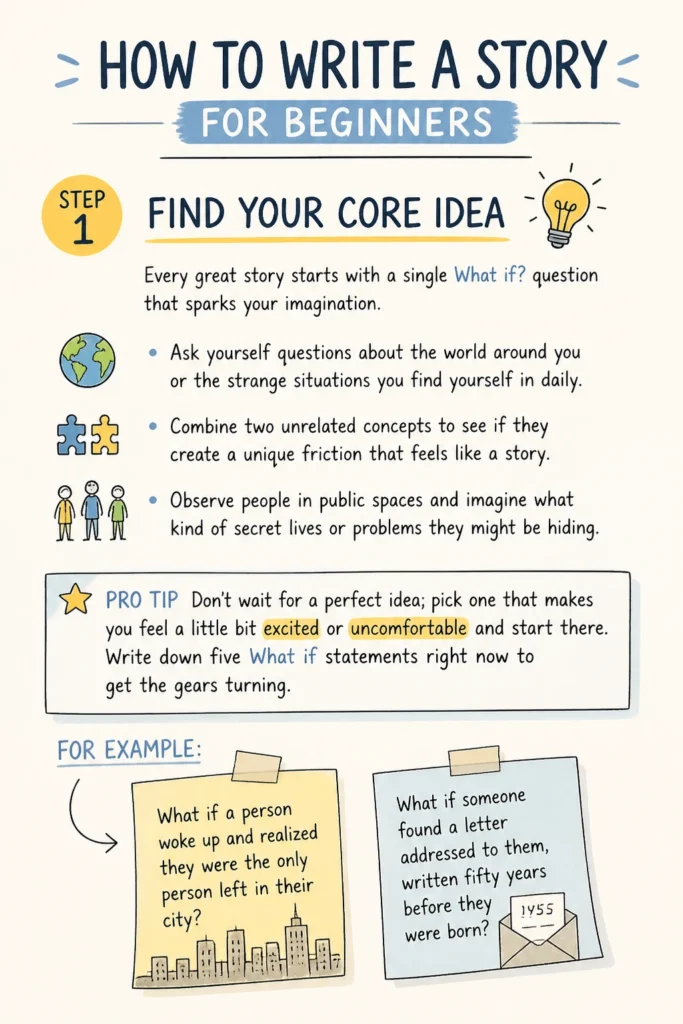
Ask yourself questions about the world around you or the strange situations you find yourself in daily.
Combine two unrelated concepts to see if they create a unique friction that feels like a story.
Observe people in public spaces and imagine what kind of secret lives or problems they might be hiding.
Pro Tip: Don’t wait for a “perfect” idea; pick one that makes you feel a little bit excited or uncomfortable and start there.
Write down five “What if” statements right now to get the gears turning.
For example, what if a person woke up and realized they were the only person left in their city?
Or what if someone found a letter addressed to them, written fifty years before they were born?
Step 2: Build a Relatable Protagonist
Your protagonist is the engine of your story, and they need a clear goal to move forward.

Give your character a specific “Want” that they are actively trying to achieve throughout the plot.
Identify a “Need” which is an internal growth or realization they must have to truly succeed.
Create a flaw that makes them human and gives them room to grow as the story progresses.
Pro Tip: A character who is too perfect is boring; readers connect with people who struggle and fail before they win.
Think about why your character wants what they want.
If they want to win a race, is it for the trophy or to prove something to a distant parent?
The deeper the motivation, the more the reader will care about the outcome.
Step 3: Establish the Stakes
Stakes are the consequences of what happens if your character fails to reach their goal.

Determine what the character loses if they do not succeed in their mission.
Escalate the tension by making the consequences personal and immediate rather than vague or distant.
Ensure the reader understands why the character cannot simply walk away from the conflict.
If the stakes are low, the reader will lose interest because the outcome doesn’t matter.
High stakes don’t always mean saving the world; they can be as simple as losing a friendship or a job.
The key is that the outcome must feel like the end of the world to the character involved.
Step 4: Map Out the Setting
The setting is more than just a backdrop; it should influence the mood and the actions of the characters.

Choose a location that creates natural obstacles for your protagonist to overcome.
Use sensory details like smells, sounds, and textures to make the environment feel lived-in and real.
Consider how the time period or the weather affects the way your characters interact with each other.
Pro Tip: Show the setting through the eyes of your character so their personality colors the description.
A character who is sad will notice the grey clouds and the puddles on the ground.
A character who is in love might notice the way the light hits the glass of a nearby window.
Avoid long lists of descriptions and instead weave the details into the action of the scene.
Step 5: Outline the Plot Structure
A basic structure helps you stay on track and prevents the middle of your story from sagging.
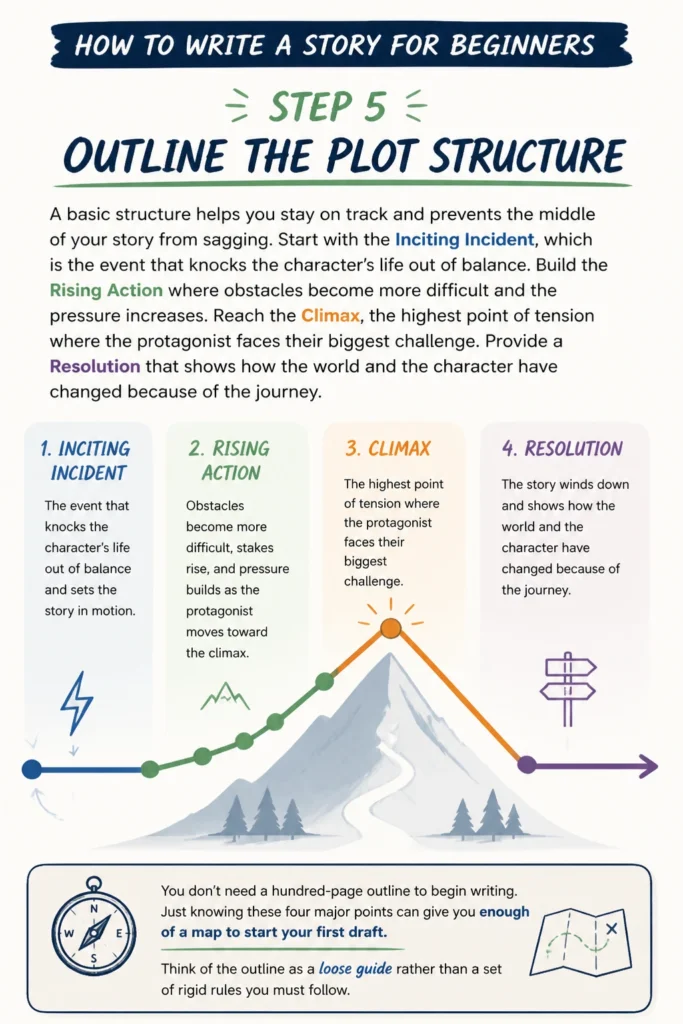
Start with the Inciting Incident, which is the event that knocks the character’s life out of balance.
Build the Rising Action where obstacles become more difficult and the pressure increases.
Reach the Climax, the highest point of tension where the protagonist faces their biggest challenge.
Provide a Resolution that shows how the world and the character have changed because of the journey.
You don’t need a hundred-page outline to begin writing.
Just knowing these four major points can give you enough of a map to start your first draft.
Think of the outline as a loose guide rather than a set of rigid rules you must follow.
Step 6: Choose Your Point of View
The Point of View (POV) determines how much information the reader gets and how close they feel to the action.

Select First Person (“I”) if you want an intimate, immediate connection between the reader and the narrator.
Opt for Third Person Limited (“He/She”) to stay close to one character while maintaining some narrative distance.
Try Third Person Omniscient if you want to know the thoughts and feelings of every character in the scene.
Pro Tip: Beginners often find First Person or Third Person Limited the easiest to manage without getting confused.
Whichever you choose, try to stay consistent throughout the entire story.
Switching perspectives mid-scene can confuse the reader and break the immersion.
Think about which character has the most to lose in the story and tell it from their perspective.
Step 7: Write the “Vomit” Draft
The first draft is for your eyes only, and its only job is to exist so you can fix it later.
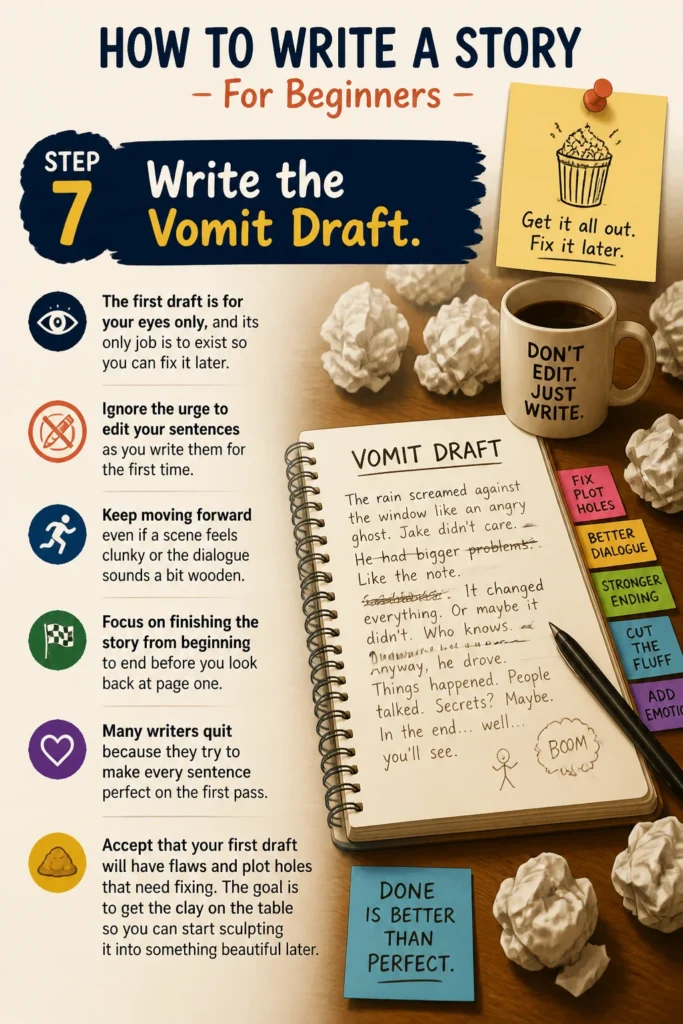
Ignore the urge to edit your sentences as you write them for the first time.
Keep moving forward even if a scene feels clunky or the dialogue sounds a bit wooden.
Focus on finishing the story from beginning to end before you look back at page one.
Many writers quit because they try to make every sentence perfect on the first pass.
Accept that your first draft will have flaws and plot holes that need fixing.
The goal is to get the clay on the table so you can start sculpting it into something beautiful later.
Step 8: Revise and Polish
Writing is actually rewriting, and this is where the real magic happens.
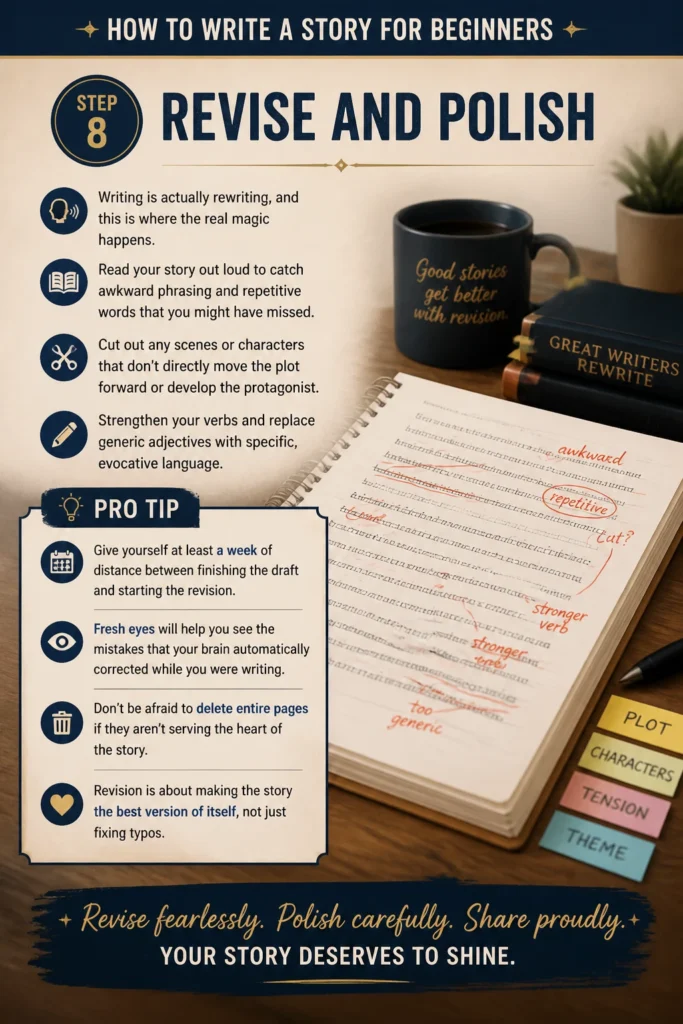
Read your story out loud to catch awkward phrasing and repetitive words that you might have missed.
Cut out any scenes or characters that don’t directly move the plot forward or develop the protagonist.
Strengthen your verbs and replace generic adjectives with specific, evocative language.
Pro Tip: Give yourself at least a week of distance between finishing the draft and starting the revision.
Fresh eyes will help you see the mistakes that your brain automatically corrected while you were writing.
Don’t be afraid to delete entire pages if they aren’t serving the heart of the story.
Revision is about making the story the best version of itself, not just fixing typos.
Common Mistakes to Avoid
The Information Dump
New writers often feel the need to explain every detail of the world and the character’s history in the first chapter. This slows the story to a crawl and bores the reader before the action even starts. Instead, reveal information only when it becomes necessary for the reader to understand what is happening right now.
Passive Protagonists
A story where things simply happen to the main character is rarely engaging. If your protagonist spends the whole book reacting to others or waiting for someone to save them, the reader will lose interest. Ensure your character makes choices that drive the plot forward, even if those choices turn out to be mistakes.
Dialogue That Is Too Realistic
Real-life conversation is full of “um,” “uh,” and boring small talk like “How are you?” and “I’m fine.” Story dialogue should sound like real speech but be much more focused and purposeful. Every line of dialogue should either reveal something about a character or move the plot toward the next conflict.
Troubleshooting
The Sagging Middle
If you find yourself stuck halfway through and the story feels like it’s dragging, you likely need a new conflict. Introduce a complication that forces the character to change their plan or raises the stakes significantly. A surprise twist or a betrayal can often provide the energy needed to push through to the end.
Writer’s Block
This often happens when you aren’t sure what happens next or you are being too hard on yourself. Try writing a “zero pressure” scene that doesn’t have to be in the book, like two characters having lunch. Often, just the act of moving your fingers across the keys will help the ideas start flowing again.
The Ending Feels Rushed
If your resolution happens too quickly, the reader might feel cheated out of a satisfying conclusion. Go back and make sure the protagonist truly had to struggle to win. Ensure that the climax is the most difficult thing they have ever done, and give them a moment to breathe afterward so the reader can process the change.
Key Takeaways
- Start with a simple “What if” question to spark your initial idea.
- Create a character with a clear desire and a significant internal flaw.
- Use a basic four-point structure to keep your narrative on the right path.
- Focus on finishing the first draft without stopping to edit your work.
- Revision is the most important part of the process for creating a quality story.
- Read your work aloud to find the natural rhythm and flow of your prose.
Frequently Asked Questions
How long should a short story be?
A short story is usually between 1,000 and 7,500 words. If you go under 1,000 words, it is often called flash fiction. If you go over 7,500, you are moving into novelette or novella territory. For beginners, aiming for 2,500 to 3,000 words is a great way to practice structure without getting overwhelmed.
Do I need to know the ending before I start?
Some writers prefer to know exactly where they are going, while others like to discover the ending as they write. If you find yourself getting stuck, having a rough idea of the destination can help you stay motivated. However, don’t be afraid to change the ending if the characters lead you in a better direction during the writing process.
How do I make my characters sound different from each other?
Give each character a unique “voice” by thinking about their background, education, and personality. One person might use short, blunt sentences, while another might use long, flowery language. Pay attention to the specific words they choose and whether they use slang, formal speech, or specific technical terms.
Is it okay to use tropes in my story?
Tropes are common storytelling patterns that readers recognize and often enjoy. You can use them as a foundation, but try to put your own unique spin on them to keep the story fresh. The goal is to use the familiarity of a trope to ground the reader while surprising them with your specific execution.
Our Top Recommended Finds
- A High-Quality Paper Notebook: Having a physical place to jot down ideas away from a screen helps many writers think more creatively.
- A Mechanical Keyboard: If you plan on writing long-form stories, a comfortable keyboard can reduce hand strain and make the process more enjoyable.
- A Reference Book on Plot Structure: Books that break down classic story beats can be incredibly helpful when you feel lost in your outline.
Taking Your First Steps Into Fiction
The most important thing you can do today is to stop thinking about writing and actually start doing it.
Pick one of the “What if” questions you thought of earlier and write just one page of description or dialogue.
You might also want to look into local writing groups or online forums where you can share your work and get feedback.
Every famous author started exactly where you are right now, with a blank page and a single idea.
Go ahead and put that first sentence down; the rest of the story is waiting for you to find it.